The latest edition of ASME B31.4-2025 is issued on 31st Dec 2025 by the ASME. This Code will become effective 6 months after the Date of Issuance which means from 1st July 2026 onwards and remain valid till the issuance of the next edition of this code which is scheduled for publication in 2028. The ASME B31.4 Pipeline Transportation Systems for Liquids and Slurries is one of the most important standards in the ASME B31 Pressure Piping Code series. It governs the design, materials, construction, inspection, examination, testing, operation, and maintenance of liquid pipeline systems, including pipelines transporting crude oil, petroleum products, liquid hydrocarbons, anhydrous ammonia, carbon dioxide, and aqueous slurries of nonhazardous materials.
The 2025 edition updates the 2022 version and continues ASME’s effort to align pipeline engineering practices with modern technologies, safety expectations, and regulatory requirements.
This article summarizes the four key changes of the ASME B31.4-2025 edition for pipeline engineers, operators, inspectors, and EPC contractors. Kind request to readers of the article to highlight other major changes that every pipeline engineer should know in the comments section.
1. Inclusion of Sustained Stress Indices (I) for Pipeline Stress Calculation:
For the first time ASME B31.4 includes the application of sustained stress indices (I) for analysis of sustained loads during pipeline stress calculation. The minimum value to be considered for sustained stress indices is 1.0. When more directly applicable data for sustained stress indices are not available, It’s value can be determined in accordance with ASME B31J Table 1-1, General Note (d). However, the designer of the pipeline system is responsible to determine the applicable sustained stress indices if a piping component is not specifically addressed in ASME B31J.
2. Modification of Longitudinal Stress (SL) Equations for Unrestrained Pipe:
The equations for longitudinal stress (SL) due to sustained loads for unrestrained pipelines are modified entirely. Now the equations approximately matches with the equations provided in ASME B31.3 code. The changes in longitudinal stress equations is given below:
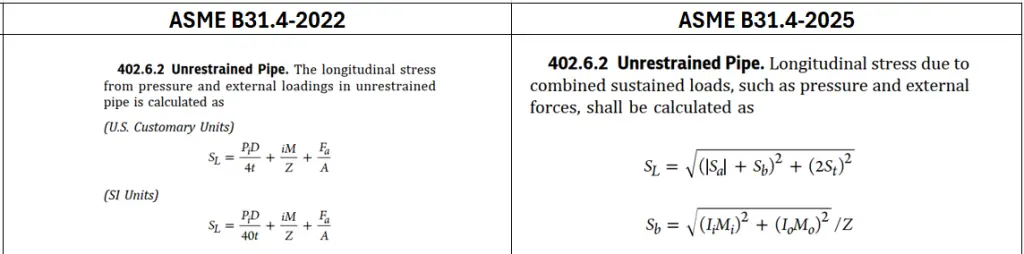
Refer to ASME B31.4, respective editions for the notations and meaning of the terms.
3. Clarifications for Meaning of Suspension of Operation:
The 2025 edition of ASME B31.4 clarifies the meaning and requirements for a pipeline suspension of operation and abandonment. It states,
“Suspending operation of a piping system for any length of time is not considered abandonment. All relevant operation and maintenance procedures shall continue to be applied as if the system were still in service.”
4. Changes in the Calculation of Section Modulus and Cross Sectional Area for Unrestrained Pipe:
ASME B31.4-2025 has updated the calculation of Sustained Section modulus (Z) and Cross Sectional Area (A) with respect to its earlier edition. Now, both the mentioned parameters need to be calculated using nominal pipe dimensions less allowances. Till 2022 edition of ASME B31.4, all these calculations were based on nominal pipe thicknesses.
So, ASME B31.4-2025 made the longitudinal stress calculation for unrestrained liquid and slurry pipelines more conservative and stress engineers will find more difficulty in its qualification.
Also, the unit system (US system or SI system) specific equations are now removed and ASME B31.4, 2025 edition provides one single equation for each variables in both units.
These are the four major changes that are known to us till date. If you come across any other changes please mention the same in the comments section and we will add those in due course.