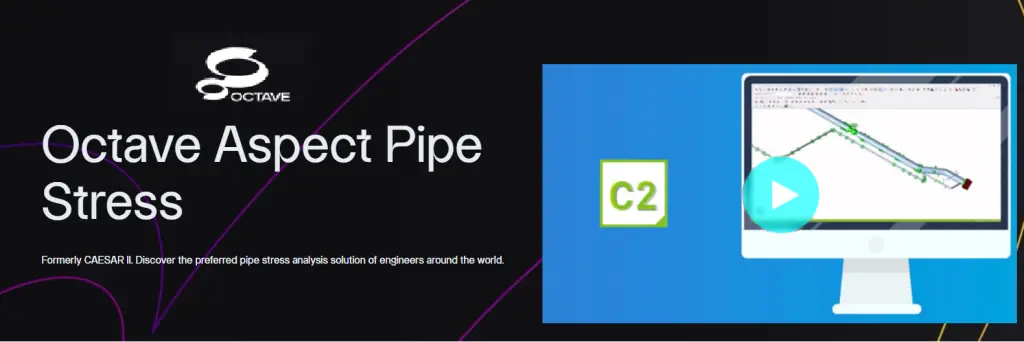
For decades, “CAESAR II” has been one of the most widely used names in pipe stress analysis, supporting projects across industries, including refining and power generation. In 2026, as Hexagon prepared the transition of its Asset Lifecycle Intelligence portfolio under the Octave brand, CAESAR II was reintroduced as Octave Aspect Pipe Stress (formerly CAESAR II).
If you’re an engineer wondering what changed, or you’re evaluating pipe stress analysis tools for the first time, this guide walks through what “Octave Aspect Pipe Stress” is, what it does, and how it relates to CAESAR II.
The Rebranding: Why the Change?
The shift from CAESAR II to Octave Aspect Pipe Stress is more than a name update. It aligns the product with Octave’s Aspect engineering analysis portfolio and Octave’s broader software brand.
Octave positions Aspect Pipe Stress as a modern pipe stress analysis solution that supports global codes and standards and integrates with Octave design and analysis tools, including Octave Forte 3D and Octave Forte 3DWorx, to streamline workflows and reduce rework.
Core Capabilities of Octave Aspect Pipe Stress
At its core, Aspect Pipe Stress is a comprehensive pipe stress analysis solution that enables engineers to model, evaluate, and report on piping systems of any size under a wide range of operating and environmental conditions.
1) Static and dynamic analysis
Aspect Pipe Stress supports both static and dynamic analysis, including common real-world loading scenarios such as:
- Weight, pressure, and thermal loads
- Wind/wave and seismic loads (as applicable)
- Dynamic analysis, including modal, response spectrum, harmonic, and time history methods
2) Global code and standards support
Aspect Pipe Stress supports dozens of international piping codes and standards (Octave cites 35+ and also references 50+), helping teams standardize analysis across global projects.
3) Equipment and connection checks (via auxiliary modules)
Beyond the piping model, Aspect Pipe Stress includes auxiliary capabilities for:
- Equipment nozzle analysis (per multiple industry standards)
- Flange analysis (including ASME and EN 1591)
Key Features of Octave Aspect Pipe Stress
Aspect Pipe Stress combines proven pipe stress analysis capabilities with workflow features designed to reduce rework and improve model quality.
Collaboration and interoperability
Aspect Pipe Stress supports cross-discipline workflows through bidirectional integrations with tools like Aspect Pressure Vessel and interoperability with design solutions such as Octave Forte 3D and Octave Forte 3DWorx, helping keep design and analysis data aligned.
Model validation
Aspect Pipe Stress includes built-in error checking and clash detection to help identify issues early and avoid interference with critical equipment.
Integration with Octave design tools
Aspect Pipe Stress can exchange piping design data with Octave design solutions (including Forte 3D and Forte 3DWorx), helping streamline handoffs between design and stress analysis and reducing duplicate data entry.
Other important features are:
- Quality assurance and regulated-industry readiness: Aspect Pipe Stress is developed and maintained under a QA program that cites ASME NQA-1, plus 10 CFR Part 21 and 10 CFR Part 50 Appendix B, and the team is conformant with ISO 9001. (This is a strong differentiator for nuclear and high-integrity work.)
- Built-in error checking + clash detection: Call out the practical outcome: fewer interferences with critical equipment, fewer late redesigns.
- Interoperability details engineers care about: Mention bidirectional integration between Aspect Pipe Stress and Aspect Pressure Vessel (analysis) and with Forte 3D / Forte 3DWorx (design). You can also mention the ability to import PCF from many third-party design tools.
- Analysis breadth (concrete list): Static + dynamic with modal, response spectrum, harmonic, time history, plus mention load types like thermal, wind/wave, seismic, and support for buried/subsea scenarios (as applicable).
- Auxiliary modules: Flange analysis (ASME and EN 1591) and equipment nozzle analysis (multiple standards), plus references like WRC 107/297 and B31G (where available).
- Productivity features: Built-in piping wizards, templates for load cases, and report generation in common formats.
Why does it matter for engineers?
Change can be disruptive, but the main practical takeaway is straightforward: CAESAR II is now Octave Aspect Pipe Stress, and the product continues to focus on standards-based pipe stress analysis, reporting, and interoperability with Octave design and analysis tools.
- Continuity: If you have existing CAESAR II-based workflows, the rebrand primarily affects product naming and portfolio alignment under Octave.
- Workflow efficiency: Aspect Pipe Stress emphasizes integrations with Octave design solutions (including Forte 3D and Forte 3DWorx) to reduce rework and keep design and analysis data aligned.
- Model quality: Built-in error checking and clash detection help catch issues early.
Conclusion: The future of pipe stress analysis
Octave Aspect Pipe Stress is the current name for the solution formerly known as CAESAR II. It remains positioned as an industry-leading pipe stress analysis tool with broad code support, robust analysis options, and integrations that help engineering teams deliver safer, more compliant designs.