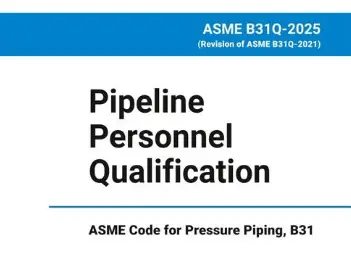
The latest revision of ASME B31Q-2025 introduces several targeted updates aimed at clarifying requirements for pipeline personnel qualification programs. While the new edition does not radically change the structure of the standard, it provides important clarifications, refined terminology, and a small number of technical updates that will affect how operators implement Operator Qualification (OQ) programs.
For pipeline operators, contractors, and training managers, understanding these changes is essential to ensure compliance and maintain effective workforce qualification processes. This article provides a detailed overview of the key updates introduced in the 2025 edition and what they mean for pipeline operations.
Overview of ASME B31Q
Before examining the updates, it is helpful to briefly review the role of ASME B31Q within the pipeline industry.
B31Q is an international industry standard that establishes requirements for developing and implementing pipeline personnel qualification programs, commonly referred to as Operator Qualification (OQ) programs. The standard provides guidance on:
- Identifying covered tasks that impact pipeline safety or integrity
- Establishing qualification requirements for personnel performing those tasks
- Evaluating knowledge, skills, and abilities of workers
- Managing and maintaining qualification records
The standard supports pipeline safety by ensuring that individuals performing critical tasks possess the necessary competence to carry out those activities safely and effectively.
Key Changes Introduced in ASME B31Q-2025
The 2025 edition introduces several updates designed primarily to improve clarity and strengthen implementation practices rather than fundamentally altering the standard. These revisions include a new covered task, wording clarifications, updates related to span of control, and guidance on evaluation methods.
1. Addition of a New Covered Task
One of the most notable technical changes in ASME B31Q-2025 is the introduction of a new non-destructive testing (NDT) task.
Vacuum Box Inspection of Tank Welds
The standard now includes vacuum box inspection of tank welds as a covered task. This addition expands the existing list of NDT-related activities within the standard.
Vacuum box testing is commonly used to detect leaks in welded seams by applying a vacuum to a sealed test area while observing for bubble formation. Including this task ensures that personnel performing this inspection technique are properly qualified under OQ programs.
The addition reflects the industry’s continued focus on inspection reliability and leak prevention, particularly in storage tank and pipeline facility applications.
2. Revisions to Existing Tasks
In addition to adding a new task, the 2025 revision updates several existing tasks listed in the standard.
Approximately seven tasks were revised, although the changes are primarily editorial or clarifying in nature. The revisions aim to improve consistency in language and remove potential ambiguities without significantly altering the original intent of the requirements.
For most operators, these updates will likely require minimal adjustments to existing qualification programs. However, organizations should still review the revised wording to confirm that their task definitions and evaluation methods remain aligned with the updated standard.
3. Clarification of Mandatory Language
A significant portion of the updates involves changes in wording intended to clearly distinguish mandatory requirements from recommendations.
Several provisions in the standard previously used the terms “may” or “should.” In the 2025 edition, some of these statements have been updated to “shall.”
This change has important implications because:
- “Shall” indicates a mandatory requirement.
- “Should” indicates a recommendation or preferred practice.
For example, the standard now clearly states that individuals performing covered tasks shall be able to recognize and properly respond to abnormal operating conditions (AOCs).
Although the technical expectations remain largely the same, the revised language removes ambiguity and strengthens the enforceability of these provisions.
4. Improved Guidance on Evaluation Methods
Another important update in the 2025 edition relates to evaluation methods used to qualify personnel.
The revised language clarifies a key concept:
All tasks require knowledge, but not all tasks require skill.
This distinction helps organizations determine when a performance evaluation is necessary and when a knowledge-based evaluation may be sufficient.
Knowledge vs. Skill-Based Tasks
- Knowledge-based tasks involve understanding procedures, processes, or requirements.
- Skill-based tasks require coordinated physical and cognitive actions developed through practice.
Examples of skill-based activities may include:
- Welding
- Specialized equipment operation
- Certain complex inspection procedures
For many knowledge-based tasks, the standard allows knowledge evaluations for requalification, once initial performance competency has been demonstrated.
This clarification helps operators design more efficient and technically appropriate qualification programs.
5. Updates to the Covered Task List Implementation
The revised standard also clarifies how operators should implement the covered task list provided in the standard.
If an operator adopts the task list provided in Appendix A, the organization must:
- Evaluate each task for applicability.
- Remove tasks that are not relevant to their operations.
- Document the rationale for excluding those tasks.
This ensures that OQ programs are tailored to actual operational activities rather than simply adopting the entire list without review.
Maintaining unnecessary tasks in a qualification program can create confusion and may raise questions during regulatory audits. Therefore, the updated guidance encourages operators to maintain a clean and defensible task list aligned with their operations.
6. Enhanced Clarification of “Span of Control”
Another area receiving attention in the 2025 revision is span of control, which refers to the supervision of non-qualified personnel performing covered tasks.
The updated language clarifies that:
- A qualified individual must be physically present while observing the work.
- The qualified person must direct and observe the entire performance of the task.
This clarification addresses common misunderstandings in which qualified personnel were not continuously observing the work.
The revision emphasizes that supervision must be active and continuous, particularly when non-qualified individuals are performing safety-critical tasks.
7. Clarification Regarding Helpers
The standard also clarifies the role of helpers during task performance.
Helpers typically assist with physical labor but do not perform the technical aspects of the covered task. The updated guidance clarifies that individuals who contribute only manual assistance without specialized knowledge or skill may not require qualification under the OQ program.
This clarification helps organizations properly categorize personnel involved in operations while maintaining compliance with qualification requirements.
8. Future Updates and Code Case Development
Although not included in the 2025 edition, the B31Q committee is developing additional guidance related to span of control determination methods.
A future non-mandatory appendix is expected to describe how span-of-control ratios were originally developed using consensus processes. This guidance may be released through an ASME code case before appearing in a future edition of the standard.
This upcoming guidance will help operators justify their supervisory ratios and improve transparency in OQ program design.
What These Changes Mean for Pipeline Operators
Overall, the 2025 edition of ASME B31Q focuses on clarification, consistency, and improved implementation guidance rather than major structural changes.
For most organizations, the practical impacts will include:
- Reviewing qualification programs for the new NDT task
- Updating documentation to reflect revised wording
- Ensuring span-of-control supervision practices align with the clarified requirements
- Re-evaluating covered task lists for operational relevance
- Reviewing evaluation methods to differentiate knowledge-based and skill-based tasks
These updates ultimately help organizations develop more defensible, efficient, and safety-focused qualification programs.
Final Thoughts
The ASME B31Q-2025 revision reinforces the importance of well-structured operator qualification programs in maintaining pipeline safety and operational integrity. By clarifying requirements, refining terminology, and introducing targeted updates, the standard provides improved guidance for organizations responsible for training and qualifying pipeline personnel.
Although the changes are relatively modest, they emphasize a broader industry trend: greater clarity, accountability, and alignment between standards and regulatory expectations.
Pipeline operators, contractors, and training managers should carefully review the new edition to ensure their OQ programs remain aligned with the latest industry guidance and best practices
Free Webinar on What’s New on ASME B31Q-2025
Refer to the following free video tutorial to learn more on the subject: