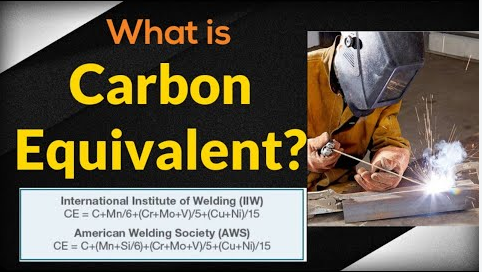
Carbon equivalent (CE) is one of the most useful concepts in steel metallurgy and welding engineering. Although the name suggests that it is simply another way of expressing carbon content, its real purpose is much broader: carbon equivalent provides a convenient numerical way to estimate how carbon and other alloying elements collectively influence the hardenability, weldability, heat-affected zone (HAZ) behavior, and susceptibility to hydrogen-induced cold cracking of steel.
This becomes especially important when welding structural steels, pipelines, pressure-containing components, offshore structures, and other critical steel fabrications. A steel may have a relatively low carbon content but still exhibit challenging welding characteristics because of its manganese, chromium, molybdenum, nickel, copper, vanadium, or silicon content.
That is where the carbon equivalent formula becomes valuable.
By converting the influence of several alloying elements into a single carbon-equivalent value, engineers can compare different steel compositions and make better decisions about preheating, welding procedures, heat input, filler metals, hydrogen control, and post-weld treatment.
What Is Carbon Equivalent in Steel?
Carbon equivalent is a calculated value that represents the combined effect of carbon and selected alloying elements on a steel’s behavior.
The underlying idea is straightforward. Carbon has a major influence on the hardenability and weldability of steel, but it is not the only element that matters. Other alloying elements can also increase hardenability. Therefore, rather than considering each element independently, a carbon equivalent formula assigns different weighting factors to the elements and expresses their combined effect as an equivalent carbon percentage.
In practical terms:
Carbon equivalent tells us how the alloying chemistry of a steel behaves, from a hardenability and weldability perspective, compared with a simpler carbon steel.
The concept was originally developed to provide a numerical indication of the carbon content that would produce a similar level of hardenability. It was subsequently extended to help assess the susceptibility of steel to hydrogen cracking during welding. Carbon-equivalent relationships can also be associated with properties such as hardness, toughness, and strength.
This is why carbon equivalent is particularly important in steel welding.
Why Is Carbon Equivalent Important for Weldability?
When steel is welded, the area immediately surrounding the weld experiences rapid heating followed by cooling. This produces changes in the microstructure of the heat-affected zone (HAZ).
If the steel has sufficient hardenability, rapid cooling can result in the formation of hard microstructures such as martensite. A hard HAZ is generally less forgiving when hydrogen and residual stresses are present, increasing the possibility of hydrogen-induced cold cracking.
Consequently, a higher carbon equivalent generally indicates:
- Greater hardenability
- Greater potential HAZ hardness
- Increased welding difficulty
- Greater susceptibility to hydrogen-assisted cold cracking
- A greater possibility that preheating or other welding controls will be required
Carbon equivalent is therefore an important screening parameter when assessing whether a particular steel can be welded using a proposed procedure.
However, it is important to remember that CE is not a complete weldability assessment by itself. Actual cracking susceptibility also depends on factors such as hydrogen level, restraint, cooling rate, heat input, plate thickness, joint configuration, and welding procedure.
Carbon Equivalent Formula: The Most Common Equations
There is not one universal carbon equivalent formula for every steel and every application.
Different formulas were developed for different purposes, steel compositions, and ranges of carbon content. Two of the most widely encountered equations are the IIW carbon equivalent and the AWS-type carbon equivalent.
1. IIW Carbon Equivalent Formula
The International Institute of Welding (IIW) carbon equivalent is commonly expressed as:
CEIIW = C + Mn/6 + (Cr + Mo + V)/5 + (Cu + Ni)/15
Where:
- C = carbon content, %
- Mn = manganese content, %
- Cr = chromium content, %
- Mo = molybdenum content, %
- V = vanadium content, %
- Cu = copper content, %
- Ni = nickel content, %
This equation became a widely accepted measure of steel weldability after the IIW adopted a simplified form of the earlier Dearden and O’Neill relationship. It has subsequently appeared in various standards and welding codes.
Example of IIW Carbon Equivalent Calculation
Suppose a steel has the following chemical composition:
- C = 0.06%
- Mn = 1.46%
- Cr = 0.04%
- Mo = 0.08%
- V = 0.01%
- Cu = 0.11%
- Ni = 0.27%
The calculation becomes:
CEIIW = 0.06 + 1.46/6 + (0.04 + 0.08 + 0.01)/5 + (0.11 + 0.27)/15
The resulting carbon equivalent is approximately:
CEIIW ≈ 0.35
This type of calculation demonstrates how a steel containing relatively little carbon can still have a meaningful carbon equivalent because of its alloying elements.
2. AWS Carbon Equivalent Formula
Another commonly referenced equation is the AWS form:
CEAWS = C + (Mn + Si)/6 + (Cr + Mo + V)/5 + (Cu + Ni)/15
The key difference is that silicon is included with manganese in the first alloying-element term.
The AWS equation therefore gives a somewhat different result from the IIW equation for the same chemical composition, particularly when silicon content is significant.
This difference illustrates an important point:
Never compare carbon-equivalent values without checking which formula was used.
A reported value such as CE = 0.40 is incomplete engineering information unless the calculation method or applicable standard is also known.
Carbon Equivalent vs Carbon Content: What Is the Difference?
It is easy to confuse carbon content with carbon equivalent, but they are not the same thing.
Carbon content is the actual percentage of carbon present in the steel.
Carbon equivalent is a calculated value that considers carbon plus the effects of selected alloying elements.
For example, two steels could contain approximately the same amount of carbon but have different levels of manganese, chromium, molybdenum, nickel, copper, or vanadium.
Their carbon contents might look similar on a material certificate, yet their hardenability and welding behavior could be substantially different.
Carbon equivalent provides a way to capture some of those differences in a single number.
Understanding Carbon Equivalent and Weldability Ratings
A commonly published classification associates carbon-equivalent ranges with general weldability:
| Carbon Equivalent | General Weldability |
|---|---|
| Up to 0.35 | Excellent |
| 0.36–0.40 | Very good |
| 0.41–0.45 | Good |
| 0.46–0.50 | Fair |
| Above 0.50 | Poor |
These ranges are useful as a general guide, but they should not be treated as universal acceptance limits for every steel, thickness, welding process, or code.
For example, a steel with a CE of 0.48 should not automatically be rejected for welding. Instead, the value should trigger a more careful review of the welding procedure and conditions.
Depending on the material and application, controls may include:
- Preheating
- Controlled interpass temperature
- Appropriate heat input
- Low-hydrogen consumables
- Proper consumable storage
- Hydrogen control
- Controlled cooling
- Post-weld heat treatment where required
- Suitable joint design
- Welding procedure qualification
The objective is not simply to achieve a low CE number; it is to control the complete set of factors that determine cracking risk.
Why High Carbon Equivalent Can Increase Hydrogen Cracking Risk
One of the most important reasons engineers calculate CE is to evaluate the potential for hydrogen-assisted cold cracking.
Three conditions are particularly important in this type of cracking:
- A susceptible microstructure, often associated with high HAZ hardness
- The presence of diffusible hydrogen
- Tensile stresses or restraint
Carbon equivalent helps address the first part by providing an indication of hardenability and the potential for HAZ hardness.
During welding, hydrogen can enter the weld region from several sources, including moisture and contamination. If the HAZ cools rapidly and forms a hard microstructure while hydrogen remains available and tensile stresses are present, cracking may develop.
This explains why carbon equivalent and hydrogen control are closely connected in welding engineering.
Why There Are Several Carbon Equivalent Formulas
A common question among engineers and welding professionals is:
Why not simply use one carbon equivalent equation for all steels?
The reason is that steel compositions have evolved considerably, and different formulas were developed using different datasets and for different purposes.
The classic IIW equation works well for many conventional carbon and low-alloy steels. However, its applicability becomes less ideal for some modern low-carbon high-strength steels.
For example, the Pcm formula developed by Ito and Bessyo was designed using a wider range of steels and is particularly associated with modern low-carbon steels, including steels commonly used in pipeline manufacturing. TWI notes that Pcm is generally used for modern steels with carbon contents of approximately 0.11 wt% or lower.
Other formulas include:
- Pcm
- CEq
- CEN
- CEw
- CET
- CEIIW
- Other composition- or application-specific carbon equivalents
The existence of these equations is not a sign that carbon equivalent is unreliable. Instead, it reflects the fact that different steel chemistries behave differently during welding.
Pcm Formula and Modern Low-Carbon Steels
The Pcm, or critical metal parameter, is particularly relevant when dealing with modern low-carbon steels.
Unlike the traditional IIW equation, Pcm gives greater relative importance to carbon and uses different coefficients for the alloying elements.
A commonly used form is:
Pcm = C + Si/30 + (Mn + Cu + Cr)/20 + Ni/60 + Mo/15 + V/10 + 5B
Here, boron is also included, which is significant because even small additions of boron can influence hardenability.
The Pcm approach was developed specifically to improve assessment for steels where the conventional IIW carbon equivalent is less suitable.
This is particularly important in modern pipeline and high-strength steel applications, where carbon levels may be deliberately kept low while strength is achieved through controlled alloying and processing.
What Is CEN Carbon Equivalent?
Another carbon-equivalent approach is CEN, developed to evaluate the weldability of a wide variety of steels.
An interesting feature of CEN is that its relationship with other carbon equivalents changes depending on carbon content.
For steels with carbon content at or below approximately 0.17%, research discussed by TWI indicates a relationship between CEN and Pcm:
CEN = 2Pcm − 0.092
For carbon contents at or above approximately 0.17%, the relationship becomes closer to the IIW carbon equivalent:
CEN = CEIIW + 0.012
These relationships demonstrate why selecting an appropriate carbon-equivalent equation is important rather than treating every CE calculation as interchangeable.
Carbon Equivalent and Heat-Affected Zone Hardness
The HAZ is one of the most important regions to consider when welding steel.
Unlike the weld metal, the HAZ is not intentionally deposited. Instead, it is the parent material whose microstructure is changed by the heat of welding.
If the steel has high hardenability and the cooling rate is sufficiently fast, hard transformation products can form.
Carbon equivalent is useful because alloying elements that increase hardenability contribute to the calculated CE.
In general:
Higher CE → greater hardenability → greater potential HAZ hardness → potentially greater cracking susceptibility.
This is a simplified relationship rather than a guarantee of cracking. Cooling rate, thickness, heat input, preheat, restraint, hydrogen concentration, and the actual steel microstructure all influence the final result.
How Carbon Equivalent Helps Determine Preheat Requirements
One of the most practical applications of carbon equivalent is helping engineers determine whether preheating should be considered.
Preheating slows the cooling rate after welding. A slower cooling rate can reduce the likelihood of forming excessively hard HAZ microstructures and can also provide more opportunity for hydrogen to diffuse away before it contributes to cracking.
As a general concept, increasing CE often means that greater attention must be paid to preheat and welding procedure control.
Some commonly cited guidance indicates that preheat may become relevant as CE moves into approximately the 0.40–0.60 range, with more stringent measures potentially required at still higher values. However, actual preheat requirements must come from the applicable welding code, material specification, thickness, restraint, process, and qualified welding procedure rather than from CE alone.
Carbon Equivalent in Pipeline and Structural Steel
Carbon equivalent is particularly significant in industries where large quantities of steel must be welded reliably.
These include:
Oil and Gas Pipelines
Pipeline steels often use modern low-carbon compositions to balance strength, toughness, and weldability. Pcm and other modern carbon-equivalent approaches can therefore be particularly useful.
Structural Steel
Bridges, buildings, towers, platforms, and industrial structures may contain substantial quantities of welded steel. CE provides a useful indicator when reviewing material chemistry and welding requirements.
Pressure Vessels
Pressure-containing equipment demands careful control of welding metallurgy. Carbon equivalent can form part of the material and welding assessment.
Offshore Structures
Offshore components face demanding structural-integrity requirements. Weldability, hydrogen control, toughness, and cracking resistance are particularly important.
Heavy Equipment and Machinery
Large fabricated machinery frequently involves thick steel sections, where cooling rates and hardenability can become important considerations.
Carbon-equivalent calculations therefore have applications across a broad range of fabrication and manufacturing industries.
A Practical Carbon Equivalent Calculation Example
Consider a hypothetical steel with:
- C = 0.10%
- Mn = 1.20%
- Cr = 0.20%
- Mo = 0.10%
- V = 0.02%
- Cu = 0.15%
- Ni = 0.20%
Using the IIW formula:
CEIIW = C + Mn/6 + (Cr + Mo + V)/5 + (Cu + Ni)/15
Substituting:
CEIIW = 0.10 + 1.20/6 + (0.20 + 0.10 + 0.02)/5 + (0.15 + 0.20)/15
Therefore:
CEIIW ≈ 0.10 + 0.20 + 0.064 + 0.023
CEIIW ≈ 0.387
So the approximate carbon equivalent is:
CEIIW ≈ 0.39
Using the general classification above, this falls within the very good weldability range.
But this does not mean that the steel can automatically be welded without preheat or other precautions. The actual welding procedure still needs to consider material thickness, joint restraint, hydrogen level, heat input, ambient conditions, consumables, and the governing standard.
How to Interpret a Carbon Equivalent Value Correctly
A CE value should be treated as a decision-support parameter, not a standalone pass/fail number.
When reviewing a material certificate, consider the following sequence:
Step 1: Verify the Chemical Composition
Obtain the actual or certified percentages of the relevant alloying elements.
Step 2: Identify the Correct Formula
Determine whether the applicable specification calls for IIW CE, AWS CE, Pcm, CEN, or another parameter.
Step 3: Calculate the Value
Use consistent units and chemical-analysis values.
Step 4: Compare Against Applicable Guidance
Do not automatically apply a generic CE threshold if the project specification or welding code provides different requirements.
Step 5: Evaluate Welding Conditions
Consider thickness, restraint, heat input, cooling rate, hydrogen level, welding process, and joint configuration.
Step 6: Establish Appropriate Controls
Where necessary, introduce preheat, low-hydrogen practices, controlled interpass temperature, appropriate consumables, or other procedure requirements.
This approach is much safer than treating CE as the only determinant of weldability.
Carbon Equivalent Is Not Just a Number
The biggest misconception about carbon equivalent is that it provides a complete description of how a steel will behave during welding.
It does not.
A CE calculation is based primarily on chemical composition. But welding behavior is also governed by thermal history and mechanical conditions.
For example, two components with identical chemistry can experience different cracking risks if:
- One is much thicker than the other
- One joint has substantially greater restraint
- One welding procedure introduces more hydrogen
- One weld cools much faster
- Different welding consumables are used
- Preheat temperatures differ
- Heat input differs significantly
Therefore, carbon equivalent should be viewed as one component of a broader weldability assessment.
Modern Steelmaking Makes Carbon Equivalent Even More Relevant
Modern steelmaking increasingly uses carefully controlled alloying and processing to achieve high strength without simply increasing carbon content.
This creates steels with relatively low carbon but carefully selected additions of manganese, chromium, nickel, molybdenum, vanadium, and other elements.
Consequently, simply looking at the carbon percentage can give an incomplete picture of welding behavior.
Carbon-equivalent calculations provide a convenient way to interpret the combined contribution of these elements.
Modern analytical technologies can also determine elemental composition rapidly and calculate carbon equivalence automatically when an appropriate formula has been specified.
Key Takeaways About Carbon Equivalent in Steel
Carbon equivalent is an essential concept for anyone involved in steel welding, metallurgy, fabrication, pipelines, structural engineering, or materials selection.
The most important points are:
- Carbon equivalent combines the effects of carbon and selected alloying elements into a single value.
- Higher CE generally indicates greater hardenability and potentially greater welding difficulty.
- CE is strongly associated with HAZ hardness and hydrogen-induced cold-cracking susceptibility.
- The IIW formula is one of the most widely used carbon-equivalent equations.
- The AWS equation differs from the IIW equation by including silicon with manganese.
- Pcm is particularly relevant to modern low-carbon steels.
- CEN, CEq, CEw, CET, and other formulas have been developed for specific steel types or assessment purposes.
- A CE value should never be interpreted without knowing which formula produced it.
- Preheat, hydrogen control, heat input, thickness, restraint, and cooling rate must also be considered.
- Carbon equivalent is a useful engineering indicator, but it is not a complete weldability assessment.
Final Thoughts
When steel is welded, chemistry matters—but chemistry is only the beginning of the story.
The carbon equivalent concept provides engineers with a practical bridge between chemical composition and welding behavior. By converting the combined influence of alloying elements into a single calculated parameter, it becomes much easier to compare steels, anticipate hardenability, identify potential HAZ problems, and establish appropriate welding controls.
The most important lesson is not simply to memorize one carbon equivalent formula. It is to understand why different formulas exist and when each one is appropriate.
For conventional steels, the IIW or AWS-style equations may provide a useful starting point. For modern low-carbon steels, particularly those used in demanding pipeline applications, parameters such as Pcm and CEN may offer a more appropriate assessment. Technical guidance from welding organizations emphasizes that the suitability of a particular carbon equivalent depends on the steel composition and the purpose for which the calculation is being used.
Ultimately, a good welding decision combines carbon equivalent, material thickness, welding procedure, hydrogen control, cooling conditions, restraint, and applicable codes and standards.
That is why carbon equivalent remains such an important tool in modern welding engineering: it turns a complex chemical composition into a practical engineering indicator—helping fabrication professionals make more informed decisions before the welding arc is ever struck.