
Compressor piping stress analysis is the engineering process of checking whether the piping connected to a compressor can safely withstand the forces, moments, movements, and vibrations that occur during operation.
The key concern is that piping must be flexible enough to absorb thermal movement, but stiff enough to avoid excessive loads on the compressor nozzles and supports.
Why perform Compressor Piping Stress Analysis?
A compressor is relatively sensitive to piping loads. If the connected piping is poorly designed, it can transmit excessive forces or moments to the compressor nozzle, potentially causing:
- Compressor nozzle deformation
- Shaft/coupling misalignment
- Excessive vibration
- Leakage at flanges
- Pipe/support failures
- Excessive pipe stresses
- Fatigue or fatigue cracking
- Problems during startup/shutdown
Interview Questions for Compressor Piping Stress Analysis
Here are some of the important questions related to compressor piping (both centrifugal and reciprocating) stress analysis that every advanced pipe stress engineer should prepare.
Compressor Piping Stress Analysis Questions Set 1:
- Explain the terms blade pass frequency and rotating stall with respect to centrifugal compressors. Compare these two phenomena. Do they affect piping system vibration? If yes, how?
- Explain the roles of the lines connecting suction and discharge for reciprocating and centrifugal compressors with reference to the key valves on these lines and their roles in piping vibration.
- In the design stage, what are the key things that a pipe stress engineer can do to minimize in-service vibration in piping systems connected to centrifugal compressors?
- Explain how to identify aerodynamic and mechanically induced vibrations in centrifugal compressor piping systems in FFT and orbit plots.
- A centrifugal compressor piping system has issues with different settlement issues with respect to an adjacent support. Share your thoughts on how to minimize the effect of this differential settlement.
- Write briefly about the importance of maintaining a required free end displacement during alignment of a reciprocating compressor piping system with the compressor nozzle. Explain the merits and demerits of checking this with springs in locked and unlocked conditions. State the industry standard you can refer to for “not to exceed values”.
- Explain what is meant by largest nozzle in the language of API 617 Appendix F.
- Explain the checks required for nozzle loads as per API 617. What is meant by 1.85 times NEMA SM 23?
- Explain the difference between double-acting and 2-throw reciprocating compressors.
- What are the typical geometrical arrangements in two- and three-throw reciprocating compressors? Explain the number of pulsations per cycle. How will you find out which of these pulsations generate pulses that are in-phase, and which are out-of-phase? Explain your answer.
- Explain the difference between design approach 2 and 3 w.r.t. API 618. How to decide which approach you need to use for a particular compressor.
- Explain the purpose of a pulsation study in the context of reciprocating compressors as per API 618.
- Briefly explain the equations that go into a pulsation study.
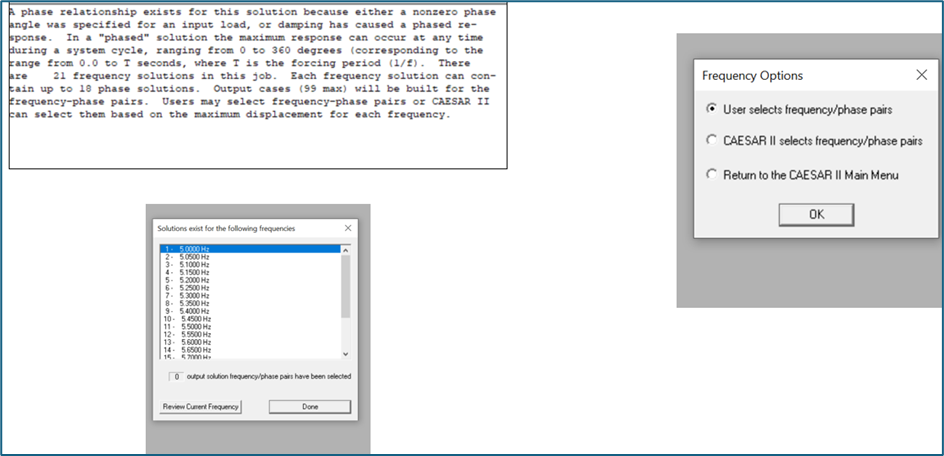
- Explain harmonic analysis in CAESAR II. How is phase calculated? Explain the significance of the following:
Compressor Piping Stress Analysis Questions Set 2:
- Explain the drawbacks and cautions of a CAESAR II-based analysis for reciprocating compressor piping systems.
- What is a mode of vibration, and explain the difference between an acoustic and structural mode. Explain the meaning of the term standing waves and the relationship between standing waves and modes of vibration (in the context of both acoustic and structural modes)
- Explain the key outputs of a pulsation study and the limitations on pulsation levels in pulsation suppression devices and piping systems as per API 618. Explain the limitations imposed by API 618 on pressure drop and shaking forces.
- What is meant by resonant and non-resonant conditions in API 618? How is non-resonant quantified?
- Is it necessary to model compressor cylinders in CAESAR II? How to model pulsation dampers in CAESAR II?
- Write a brief note on arriving at a scope of work for a pulsation study and state the reasons for the same.
- Explain some designs used to suppress pulsation in reciprocating compressor systems. What are the key aspects in designing such supports? What information is required?
- Explain the term narrow band, broad band, and white noise in the context of random vibrations. How to identify them? Explain in the context of AIV, FIV, vortex-induced vibration, and vibration of reciprocating compressor piping systems.
- Explain in detail the extent of analysis required to make sure that pulsation levels attenuate by those lengths. How to have a rough estimate of the length and how to arrive at diameter or area ratios which successfully reduce amplitude of vibration.
- Explain the concept of volume-choke-volume pulsation dampers and what is meant by Helmholtz frequency. Explain. Giving reasons, the roles of volume and choke and the significance of the term acoustic mass. Why do we refer to the small amount of physical mass in the choke as having high acoustic mass?
- Explain allowable vibration requirements from API 618. Are they for in-service vibration? If not, what documents can you use for in-service vibration?
- Explain how a viscous damper works.
Answers to Compressor Piping Stress Analysis Interview Questions
Are you looking for the answers? You can enroll in the following online course that will help you resolve most of the above questions and reinforce your learning of compressor piping stress analysis.
The above course covers the basics of pipe stress analysis for both centrifugal and reciprocating compressor piping systems.