Design Checking or checking of design is a process of validating a design and/or a design calculation to ensure that it is error-free and of good quality and is good for engineering and/or fabrication or whatever the end-use of it is.
Checking is also a process of value addition in terms of applying good engineering practices, aesthetics, reduction in cost and thereby providing better value to the client.
A design checklist is prepared for each important design process to aid in the design checking process.
Ensure a consistent design approach for similar pieces of equipment and/or unit area piping
Aesthetics
Responsibility Matrix for design check
Every individual is responsible and accountable for checking his deliverable to ensure quality and error-free design.
Every individual checks, signs, date, and then pass it on to the next individual.
Calculations/drawings received for checking by the next individual, without a sign and date, shall not be entertained/accepted!!!
Back-ups of holds and assumptions, if any, are maintained in an orderly manner before the issue
A signed and dated checklist, completely filled out is a must for any checked document as this is a quality record
The ultimate responsibility of quality and correctness lies with the lead as he is the one who enforces teams conformance to quality procedures
Checking is a collaborative effort. Every individual owns and is accountable for an error-free and quality product
Why Design Checking Adds Value
Owning responsibility and following good practices and procedures results in overall quality
The use of checklists ensures important points needing check are not missing out
Design reviews & inter-squad checks ensure interdisciplinary aspects are addressed in the design
Safety and constructability reviews ensure good overall layout, approach, constructability, maintenance, and operability
Incorporating fabrication/contractor-specific details and/or preferences into the design helps in easier and faster fabrication and lesser errors
Facilitates a once-through approach from start to finish thereby saving on time and schedule
Minimizes rework in design and at the field
Where do we stand today?
Ownership and accountability by individuals missing. “Next person will check”!!!
Do not prioritize tasks to ensure project schedules and goals are met
Work hard but do not “Work Smart”
Perform checking using either incomplete and/or superseded inputs
Do not capture design changes and revisions properly. Do not use revision notes.
Do not follow proper checking procedures, checklists, and colors from the initial stages. Keep this aside only for the final IFC check stage. Too late….!
Do not check important items/spelling. More focused on irrelevant aspects
Do not clarify checking procedures, standards, guidelines, checklists, etc. in the job notes upfront
Do not obtain early client approval on checking procedures and expectations
Do not have a checking and approval matrix for approval of various deliverables
Do not maintain discipline holds summary
Team and team leaders are often not aligned regarding the requirements/expectations of the project
Final number-crunching during the IFC issue period often affects productivity, and efficiency and lowers team morale
What Needs Improvement?
Follow a holistic approach toward checking
Approach and expectations shall be clarified upfront through job notes and induction sessions
Obtain client approvals and finalize checklists upfront
Pay attention to minor details. Spell check is also important
Work smart, prioritize, and be focused
Checklists and proper procedures shall be used religiously – this is mandatory
Always check against the latest documents to avoid rework.
Always start the final check process against a frozen and dated set of documents like P&IDs, LL, etc.
Lead to incorporate lessons learned in design into checklists as a process of procedural improvement
Lead to make expectations known to the team, fix individual responsibility and enforce accountability
Assign the right work to the right individual
The team is to be told that this is not an individual activity but a team effort. We sail or sink together!
Synopsis
Effective checking is integral to project success
Translates into quality, cost, and schedule advantage. Value+++
Checking is an innovative process, to find the best approach. One hat does not fit all!
We need to challenge a situation to come out as a winner. Think “out of the box”!
Piping Material Engineer: Roles, Responsibilities, and Activities
In the complex world of engineering and construction, the role of piping material engineers is often overlooked yet critically important. These professionals ensure that piping systems, which are fundamental to many industrial processes, function safely, efficiently, and economically.
You must be aware that there are three sub-disciplines inside the piping discipline, namely:
Piping Layout
Piping Stress
Piping Materials
Piping Materials Engineers are in the core group of the piping department. Broadly, the piping material engineer is responsible for the quality of material, creating a project pipe class, and various piping specifications required in a project to fabricate and test the piping system. Piping Materials Engineers are also sometimes called Piping Specification Engineers.
Who are Piping Materials Engineers
By Definition Piping Materials Engineers are piping engineering individuals who are responsible for creating the project piping classes and the numerous piping specifications necessary to fabricate, test, insulate, and paint the piping systems.
Whatever the title, the piping material engineer (PME) is a very important person within the Piping Design Group and should be dedicated to a project from the bid stage until the design phase has been completed. He or she should also be available during construction and through to mechanical completion.
Normally, the lead piping material engineer, the individual responsible for all piping engineering functions, usually reports directly to the project lead piping engineer. Depending on the size of the project, the lead piping material engineer may be assisted by a number of suitably qualified piping material engineers, especially during the peak period of the project. This peak period is early in the job, while the piping classes are being developed and the first bulk inquiry requisitions are sent out to vendors.
Roles and Responsibilities of Piping Material Engineers
Layout and Stress Engineer’s activities are quite evident to most people in the industry, however, the activity performed by a Piping Material Engineer is always less known and underrated. Many of us think that the piping material engineer performs only MTO (material takeoff). However, a Piping Material Engineer performs a lot of activities in a project, and his role is very important in a project.
Piping Material Engineer’s activities include but are not limited to the following:
Make sure that everyone in the piping group is aware of the materials of construction that can be used for piping systems.
To Liaise with the following departments: Piping Design and Stress, Process, Instrumentation, Vessels, Mechanical, Structural, Procurement, and Material Control.
To Maintain project technical files and update Company standards
To Perform the inter-disciplines checking for the part of documents in accordance with the scope of the piping material section.
So to summarize a Piping Material Engineer must be a Good Communicator, must have experience in Piping Design and Piping Material Properties, must be aware of corrosion characteristics of Piping Materials, must be aware of welding Processes necessary for the fabrication of piping systems, and must have a basic understanding of all other disciplines which have an interface with piping. Finally, He must be aware of economics which includes the material selection to reduce costly high-pressure and alloy piping runs and reduce the use of odd, high-cost fittings.
Activities of a Piping Material Engineer
Here are the main activities of a piping material engineer, presented in the order they typically occur as a project moves from initial planning to detailed design.
1. Development of Project Piping Classes
In process plants, there are two main types of piping systems: process piping and utility piping.
Process Piping: This is the main pathway for materials in a plant. It carries feedstock, transports products through various equipment, and delivers the finished product for further processing. Process piping can be split into:
Primary Process: The main flow of materials.
Secondary Process: Systems for recycling materials.
Utility Piping: This supports the primary process and is divided into three groups:
Support: Includes instrument air, cooling water, and steam.
Maintenance: Covers plant air and nitrogen.
Protection: Comprises foam and firewater. Other utility services include drinking water.
Piping Classes
Each piping system is assigned a piping class that outlines all necessary components for construction. A piping class includes:
Design conditions (temperature and pressure)
Corrosion protection
List of components
Branch tables
Special assemblies
Support notes
Both process and utility piping systems operate under various temperatures and pressures. Important factors to analyze include:
After examining these factors, piping systems can be grouped into classes that share similar characteristics, such as size, pressure, temperature, and joining methods. This standardization simplifies procurement, inspection, and construction.
However, there’s a balance to strike. Having too many classes can complicate paperwork and lead to errors, while too few classes may require using expensive materials for less critical services, which is known as being “overspecified.” It’s the job of the piping material engineer to optimize this classification for the project’s benefit.
For example, a typical oil and gas separation plant might have around 10 process piping classes and a similar number for utility piping. More complex petrochemical facilities may need over 50 classes to accommodate various processes and their specific temperature and pressure requirements.
2. Writing Specifications for Fabrication, Testing, Insulation, and Painting
Specifying the right materials for pipes is useless if they are built and installed by unqualified workers using poor methods, and if testing, insulation, and painting are not done properly.
The piping material engineer is tasked with creating detailed specifications for these activities to ensure they meet industry standards and the client’s needs. While each project is unique, many share similarities, and most Engineering, Procurement, and Construction (EPC) companies have general specifications that address these areas.
3. Creating Data Sheets for Process and Utility Valves
Every valve used in a process plant must have a dedicated valve data sheet (VDS). This document acts like a passport for the valve, detailing its size range, pressure rating, design temperature, materials, testing and inspection procedures, and all relevant design codes. The VDS is crucial for efficient procurement and future maintenance of the valve.
4. Creating a List of Piping Specials and Data Sheets
A piping system mainly consists of common components like pipes, fittings, and valves. However, there are also less common items, known as piping specials, such as strainers, hoses, steam traps, and interlocks. Each special item must have a unique SP number for identification.
The piping material engineer is responsible for creating and maintaining a list of SP numbers, ensuring that each special item is clearly identified by its type, material, size, and rating. Each piping special also requires its own data sheet for efficient procurement and maintenance.
5. Assembling Piping Material Requisitions with Supporting Documents
Once the piping specifications are finalized and initial quantities are determined by the Material Take-off Group, the piping material engineer assembles the requisition packages. The Procurement Department then divides the piping requirements into several requisitions, which will be sent to manufacturers that specialize in specific piping components, including:
Pipe: Seamless and welded (carbon and stainless steel), exotic materials (Inconel, Monel, titanium)
Pipe fittings: Seamless and welded (carbon and stainless steel)
Valves: Gate, globe, and check (small bore, 1.5 inches and below; 2 inches and above)
Ball valves: All sizes (carbon and stainless steel)
Special valves: Non-slam check valves, butterfly valves
Stud bolting: All materials
Gaskets: Flat, spiral wound, ring type
Special piping items (SPs): Strainers, hoses, hose couplings, sight glasses, interlocks, etc.
To obtain competitive bids, inquiries are sent to multiple manufacturers for each group of components, inviting them to provide their best prices. This includes not only supplying the items but also testing, certification, marking, packing, and shipping to the site if needed.
6. Reviewing Vendor Offers and Creating a Technical Bid Evaluation
Many clients maintain an “approved bidders list,” which includes vendors deemed suitable to supply materials based on their past performance and reliable recommendations. Prospective vendors are given a deadline to submit their bids, which must cover the specified requirements.
To foster competition, it’s best to shortlist three to six qualified vendors, ensuring they all feel they are competing with others. Even if some vendors drop out, all should believe they are in a competitive environment.
The piping material engineer evaluates all feasible bids, ensuring each vendor meets the technical specifications and is deemed “fit for purpose.” If a vendor cannot meet the requisition requirements, they are marked as technically unacceptable and excluded from further consideration.
During this evaluation, the piping material engineer creates a bid tabulation spreadsheet that lists the technical requirements for each item and assesses each vendor’s compliance. This includes evaluating materials, design codes, testing, certification, painting, as well as non-technical areas like marking and packing. The required delivery date is provided by the Material Control Group to assist in final negotiations.
The Procurement Department handles all commercial aspects, while the Project Services Group determines the delivery schedule. It’s crucial to choose a vendor who is technically acceptable and offers the best overall value, rather than just the lowest price, as the cheapest option might end up being more costly in the long run.
7. Reviewing and Approving Vendor Documentation After Purchase Order Placement
After placing an order, it’s vital to review the vendor’s documentation. Vendors must provide support documents such as inspection and testing plans, general arrangement drawings, material certifications, test certificates, and production schedules.
The piping material engineer must review and approve this documentation before the final payment can be made to the vendor.
8. Vendor Visits
The piping material engineer may need to visit the vendor’s facility to observe testing or attend clarification meetings. Some piping items are more complex due to their materials, design, or pressure ratings, requiring closer attention to ensure that the correct materials are supplied without causing production delays.
To facilitate this, the following activities should be considered:
Bid clarification meeting: Ensures the vendor fully understands the requisition.
Pre-inspection meeting: Discusses production, inspection, and quality control after the order is placed.
On-site supervision: Involves having the requisition engineer at the vendor’s facility during critical manufacturing phases.
Dedicated inspector: Places an inspector at the vendor’s site to oversee inspection and testing, ensuring specifications are followed.
The first two activities are low-cost and generally standard, while the last two may be more expensive and should be evaluated based on the complexity of the order and lead times.
Each requisition is unique; simple orders with new vendors might need more oversight than complex ones with established vendors. The decision to conduct vendor visits should also consider the inspection budget, as inadequate funding could limit on-site supervision.
Remember, receiving incorrect materials can result in high replacement costs and project delays, making it essential to ensure proper oversight, especially for custom items or those with long lead times (three months or more).
9. Bids for New Projects
In addition to project-related activities, the piping material engineer may also participate in bids for new projects invited by clients. This stage involves preliminary engineering, where accuracy is crucial, based on the client’s brief. Typical tasks include developing preliminary piping classes, basic valve data sheets, and specifications for construction, inspection, and painting.
A piping material engineer may work as part of a dedicated project task force or within a corporate group managing multiple projects at different stages. The former is often preferred, as it allows for a deeper familiarity with the evolving project.
The role of a piping material engineer is both diverse and rewarding, offering continuous learning opportunities. Even if a project has the same client, process, and geographical location, variations in personnel, budgets, and market conditions lead to unique challenges. Each project brings its own set of intricacies.
It’s essential to document and maintain your knowledge—both technical and logistical—through organized files, whether digital or in hard copy.
Regardless of whether you stay with one company for 30 years or work for multiple companies for shorter stints, the role of a piping material engineer is highly respected within the field and across projects. While it is on par with piping layout or stress engineering, its significance should not be underestimated. Proper material selection is critical; if the wrong materials are used, no matter how well the pipe is laid out, all routing efforts become irrelevant.
Piping Materials Engineer Jobs
Piping Materials Engineers are highly sought-after professionals in various industries where the design, construction, and maintenance of piping systems are critical. These engineers play a vital role in ensuring the integrity, safety, and reliability of piping networks. Here are some of the key industries where Piping Materials Engineers are recruited:
Oil and Gas Industry: Piping Materials Engineers are in high demand in the oil and gas sector. They work on projects involving pipelines, refineries, offshore platforms, and petrochemical plants.
Chemical and Petrochemical Industry: Piping Materials Engineers play a critical role in selecting materials that can withstand the corrosive and hazardous chemicals used in chemical processing plants and petrochemical facilities. They ensure compliance with industry standards to maintain safety and productivity.
Power Generation: Power plants, whether nuclear, fossil fuel-based, or renewable energy facilities, require extensive piping systems for the transport of steam, water, and other fluids. Piping Materials Engineers are responsible for selecting materials that can handle high temperatures and pressures.
Pharmaceutical and Biotechnology: Industries like pharmaceuticals and biotechnology rely on sanitary and high-purity piping systems for the production of drugs and biologics. Piping Materials Engineers work to maintain product integrity and regulatory compliance.
Mining and Minerals Processing: The mining industry utilizes extensive piping networks for transporting ores, slurries, and chemicals. Piping Materials Engineers select materials that can withstand abrasive environments and prevent corrosion.
Water and Wastewater Treatment: In municipal and industrial water treatment plants, Piping Materials Engineers are responsible for designing corrosion-resistant and durable piping systems to handle water purification, distribution, and sewage treatment.
Food and Beverage Industry: Food processing and beverage production facilities require sanitary and hygienic piping systems. Piping Materials Engineers ensure that materials meet FDA (Food and Drug Administration) and other regulatory requirements.
Nuclear Industry: Piping Materials Engineers in the nuclear industry focus on materials that can withstand radiation and extreme conditions. They play a crucial role in the safe operation of nuclear power plants.
Maritime and Shipbuilding: In shipbuilding and maritime industries, Piping Materials Engineers are involved in the design and maintenance of complex piping systems for ships, offshore platforms, and maritime infrastructure.
Building and Construction: Piping Materials Engineers also find opportunities in the building and construction sector, where they work on plumbing systems, heating, ventilation, air conditioning (HVAC) systems, and other building infrastructure projects.
Renewable Energy: With the growing focus on renewable energy sources like solar and geothermal, Piping Materials Engineers are involved in designing and maintaining piping systems for these technologies.
Automotive Industry: In automotive manufacturing, Piping Materials Engineers work on the design of fluid-carrying systems, such as fuel lines, brake lines, and cooling systems.
Research and Development: Some Piping Materials Engineers are employed in research and development roles in materials science, working on innovations in materials for various industries.
Salary of a Piping Materials Engineer
The salary of a Piping Materials Engineer can vary significantly depending on several factors, including experience, location, industry, education, and the specific employer. In India, the salaries are at the lower end whereas in the USA and Europe, the salaries are higher.
Below, I’ll provide a general salary range for Piping Materials Engineers in the USA:
Entry-Level: Piping Materials Engineers who are just starting their careers can typically expect a salary in the range of $48,000 to $80,000 per year. This can vary based on location and industry demand.
Mid-Career: With several years of experience, Piping Materials Engineers can earn salaries ranging from $80,000 to $120,000 per year.
Experienced/Senior: Those with extensive experience and expertise in Piping Materials Engineering can earn salaries exceeding $120,000, often reaching $150,000 or more per year.
Stress analysis is a complex task and in any process unit, there are a huge number of lines exist which run from one location to another. Analyzing all lines will take a lot of time which in turn will increase the engineering time and corresponding cost. So every engineering organization in this field has set up some guidelines for deciding which lines are to be stress analyzed using pipe stress analysis software (Caesar II, Autopipe, Caepipe, START-PROF, or Rohr II).
What is a Critical Line List or Stress Critical Line List?
A Stress Critical Line List or SCLL is a listing of all critical lines requiring attention from a piping stress engineer during the piping design phase. It is the piping stress engineer’s responsibility to prepare one Critical Line List (CLL) by isolating the non-stress critical lines from the stress critical line based on the criteria provided in the stress analysis specification. Piping Critical Line List is also known as Flexibility Log in some EPC organizations or design consultancies.
All those critical lines are then categorized into some number of stress systems so that the stress system numbers can be easily found from the generated critical line list. The number of stress critical lines in each stress system is decided based on the engineering judgment of the stress engineer. The stress Critical Line List is an important deliverable from the piping stress team. The main inputs required from the stress critical line list preparation are:
Ideally, the critical line list should be updated as and when the process line list is updated. But to reduce frequent changes many organization prepares only three revisions of the stress critical line list. Those:
Preliminary Stress Critical Line List during the start of the project upon receipt of the first set of line lists and P&ID
Advanced Critical Line List just before 60% model review and
Final Stress Critical Line List after 90% model review.
Types of Stress Critical Lines
Stress Critical Lines are normally divided into a few groups for deciding critical lines. Those are:
Equipment Critical Lines: Lines connected to Rotary Equipment and Critical Static equipment fall in this category. For example, lines connected to pumps, compressors, and turbines are by default stress critical and require analysis using the software.
Support Critical Lines: Lines for which engineered supports are required fall in this category. Example: Supports requiring spring hangers, Pipes with SS or SDSS material where normal CS supports can not be used, etc.
Relief Critical Lines: Pipes experiencing relief loads come into this category. For example, the line connected to pressure safety valves, rupture disk, etc.
Material Critical Lines: Pipes made from SDSS and non-metals like GRE, FRP, Aluminum alloy, etc. fall in this category.
Service Critical Lines: Piping systems carrying category M fluid service, hazardous fluid service, severe cyclic condition, etc. fall into this category.
Temperature Critical Lines: Lines carrying fluids having high temperature comes into this group.
The basis for deciding Stress critical lines
The main factors which decide stress critical lines for preparing a critical line list are as follows:
Every organization has its own guidelines and the guidelines vary from project to project. The following write-up will provide a few criteria for deciding stress critical lines. This is only an idea of how differentiation occurs. The user is requested to check project-specific documents for use in any project. Mostly the critical lines for which stress analysis is to be performed by formal computer analysis consist of the following lines:
All Pump (Centrifugal-API/ANSI, gear pump, Screw pump) suction and discharge piping (4 inches and larger).
Centrifugal Compressor inlet and outlet piping.
Lines to and from steam generators.
Reciprocating pump and compressor suction and discharge piping.
Piping requiring expansion joints or other proprietary expansion devices.
All Fiberglass, aluminum alloy, refractory, or elastomer-lined piping.
All piping systems connected to FRP, plastic, glass-lined steel, or brittle equipment
Lines subjected to non-thermal movements (Expected differential settlement between structures, structure-equipment, etc., process equipment growth, header growth, tower growth, or other significant displacements, etc.)
All lines 8” and larger operating above 150 deg. C (300 deg. F) and greater.
All lines 20” and larger operating above 80 deg. C (200 deg. F) and greater.
All lines 36” and larger.
All lines operating below -45 deg. C (-50 deg. F) which requires special “cold” supports.
All plastic-lined piping systems. Special attention shall be given to adding enough additional supports to limit the external forces and moments in the flange connections to avoid an extra risk of flange leaks.
Lines with special design requirements
All Safety pressure-relieving systems 4 inches and larger (not including thermal reliefs)
In addition, the piping effects of other conditions such as temperature gradients that could cause thermal bowing or where piping is connected to equipment with significant thermal growth may warrant detailed computer analysis.
For thin wall piping, if the D/T ratio exceeds 100, the following requirements are applicable:
The design and support of piping systems using this specification should be reviewed by a stress engineer. Support and spans of thin wall piping systems are not covered by current Project practices and therefore must be designed for each application.
Stub-in connections per 304.3.2 thru 304.3.4 of ASME B31.3, are not allowed for run pipe with D/T greater than or equal to 100 and the branch diameter is greater than one-half of the header diameter.
Lines connected to non-ferrous equipment.
Underground process lines with more than a 30-degree difference between design and ambient temperature.
All vertical lines, connected to vertical vessels that require pipe supports or guides from that vessel.
All lines, 4 inches and larger subject to external pressure or vacuum conditions.
All lines, subject to vibration, as specified by Process, due to high-velocity flow, high-pressure drop, water hammer, or mixed phase flow.
All lines that are connected to equipment constructed of thermoset or thermoplastic materials or that are glass, refractory, or elastomer lined.
ISO 14692 is an international standard that specifies the requirements and recommendations for the design, construction, installation, and operation of fiberglass-reinforced plastic (FRP) piping systems in offshore and onshore oil and gas production, as well as other corrosive environments. The standard covers the use of FRP piping systems for both aboveground and belowground applications, including buried and submerged pipelines.
ISO 14692 provides guidelines for the selection of materials, design considerations, manufacturing, testing, installation, and maintenance of FRP piping systems. It also includes requirements for quality control, inspection, and certification of FRP piping systems.
The standard was developed by the International Organization for Standardization (ISO) Technical Committee TC 138, which is responsible for developing standards related to plastic pipes and fittings for non-pressure applications. ISO 14692 is intended to provide a standardized approach to the design and construction of FRP piping systems, ensuring safe and reliable operation in harsh environments such as those encountered in the oil and gas industry.
Significance of ISO 14692
ISO 14692 is significant for several reasons:
Safety: The standard provides guidelines for the safe design, construction, installation, and operation of fiberglass-reinforced plastic (FRP) piping systems in corrosive environments, such as those encountered in the oil and gas industry. By adhering to the standard, companies can ensure that their piping systems are designed to be safe and reliable, reducing the risk of accidents or failures that could lead to injury, environmental damage, or financial losses.
Quality: ISO 14692 provides requirements for quality control, inspection, and certification of FRP piping systems. By following these requirements, companies can ensure that their piping systems meet the necessary quality standards, reducing the risk of defects or failures that could compromise the integrity of the system.
Cost-effective: FRP piping systems are often more cost-effective than traditional materials such as steel or concrete, particularly in corrosive environments. By using ISO 14692 as a guide, companies can ensure that they are selecting the most appropriate materials and designs for their specific application, optimizing the cost-effectiveness of the system.
International recognition: ISO 14692 is an international standard that is recognized by organizations and companies around the world. By following the standard, companies can ensure that their FRP piping systems meet the same requirements as those used by their counterparts in other countries, facilitating international trade and collaboration.
Overall, ISO 14692 is significant because it provides a standardized approach to the design and construction of FRP piping systems, ensuring safe and reliable operation in harsh and corrosive environments. By following the standard, companies can reduce the risk of accidents or failures, ensure quality, optimize cost-effectiveness, and facilitate international trade and collaboration.
What’s New in ISO 14692-2017
In the year 2017, a renewed edition of the ISO-14692, the governing standard for fiber-reinforced plastic piping, was officially released. There are many significant changes with respect to the earlier edition. For example, there are changes in the regression gradient for qualification, the maximum pressure rating terminology, the stress intensification, stress envelope definition, the scaling rules for qualified components, buried pipe assessment, fatigue method, test methods for flanges, etc. All these changes can be studied in detail from the latest code. This article will try to explain a few of the important points in brief.
The objective of ISO 14692 is to provide the oil and gas industry, as well as the supporting engineering and manufacturing industry, with mutually agreed specifications and recommended practices for the purchase, qualification, manufacturing, design, handling, storage, installation, commissioning, and operation of GRP piping systems.
The previous official release of the code was in the year 2002. Since then the experience with FRP piping has increased significantly, and much of this experience is now included in this latest revision of the standard. Issue 2017 of the standard now contains more background to design requirements and provides more clearly defines a step-by-step set of guidelines. The standard offers a questionnaire to be filled out by the end user in the bidding stage. This questionnaire aids the end-user to provide the right information to the manufacturer and designer. Information such as pressure and temperature requirements as well as other information crucial to select the appropriate FRP piping component composition as pressure class. By providing clearer requirements for the provision of information, there is a much higher chance that all selection and design of the FRP system occurs, and conforms to the standard requirements.
Contrary to the last official release of the standard in the year 2002, the new edition addresses buried GRP piping. A pipe buried in soil with a certain cover depth will experience a vertical deflection due to the weight of the soil and additional soil loads. Previously, to assess such deflection, the engineer would need to divert to the rules and guidelines of the AWWA M45 standard. Since this assessment is already standard practice by many engineers in the design of buried piping, the AWWA M45 vertical deflection assessment was brought into the ISO-14692, thus making this a mandatory component of the assessment of buried piping when following the ISO 14692.
One aspect of the standard that did not match industry common practices has been the application of the stress intensification factors (SIF’s) and flexibility factors. Much of the original research on these values was done in the context of stress analysis of components made of anisotropic materials. The design of anisotropic components generally differs considerably from that of isotropic materials. The 2002 edition of the standard provided SIFs for fiberglass fittings which were based on the SIFs in the BS7159. A study performed by SINTEF has shown that the BS7159 underpredicts the stiffness of GRP fittings substantially, from which it can be concluded that the SIFs from the BS7159 is not applicable to GRP fittings. Therefore one common practice in the industry was to use a SIF of 2.3 in combination with modeling the true reinforced wall thickness of the applicable fitting. This modeling approach was based on the experience of the industry rather than the ISO14692 philosophy as presented in the 2002 edition of the standard.
The 2017 edition of the standard provides a new modeling approach to be used for pipe stress and flexibility analyses which are based on using a standard SIF of 1.5 in combination with an equivalent fitting thickness. The latest revision also provides a standard for the qualification of the SIF. Thereby a manufacturer also has the possibility of taking credit for a potentially lower SIF than 1.5 for a specific elbow design. Other important features of ISO 14692 have undergone very significant changes as well, such features are the qualification of GRP piping components, the standard on GRP flanges, the design stress envelope, fatigue in GRP, and static electricity.
Pipe Stress Engineer is the person who ensures that the pipe routing done by the piping designer or Engineer (Layout) is consistent with the allowable’s in the applicable piping Codes. This translates to keeping the thermal forces, and weight loads (both the live and deadweight loads) the piping system imposes on equipment, equipment nozzles, and structures within the limit set by codes or standards. Selecting and specifying stress-related products like Expansion Joints, Variable and Constant Spring Hangers, Snubbers, Struts, Etc. are also the responsibility of a Piping Stress Engineer.
So, in general, What does the Pipe Stress Engineer should know? The subject of Pipe Stress Engineering is broad enough and more than just knowing the Pipe Stress Analysis software like Caesar II, AutoPipe, Start-Prof, Caepipe, or Rohr-2.
The below-mentioned paragraphs list some of the most basic things that a good Pipe Stress Engineer should know.
Related Piping Codes
Piping codes are the bible for piping designing. Hence, It is the first and foremost responsibility of the piping stress engineer to acquire knowledge about the applicable Piping Codes for different types of Projects. He must have access to the latest copy so that proper data is used and proper decisions can be made for the calculations and the good of the project.
All Pipe Stress Engineers should know the workflow with other piping interface engineering teams like Process, Civil, Structural, Mechanical Equipment, Vessels & Tanks, and Instruments/Control Systems. These groups contribute a major part to Piping’s success just as the effort of the Pipe Stress Engineer also has a responsibility for contributing to their success.
Piping Execution
Relation of pipe stress progress to P&IDs, Plot Plans, equipment vendor drawings, instrument vendor drawings, and structural support design should be known to the stress engineer in order to understand areas where the Project may be impacted.
Process Design Variables
Awareness regarding the Process design variables is a must for the piping stress engineer.
Process Plant Equipment
All Pipe Stress Engineers need to know and understand the different types of equipment and the pipe stress-related issues that affect each type of equipment.
Equipment Operation and Internals
All Pipe Stress Engineers need to understand the equipment process function and the equipment internals in order to give proper consideration to the effect of piping connected to and reacting to the various nozzles/connections.
Equipment piping
All Pipe Stress Engineers need to know the right and the wrong way to pipe up (connect the pipe too) different kinds of equipment and for maintenance/disassembly space requirements. This includes pumps, compressors, exchangers, filters or any special equipment to be used on a specific project.
Allowable pipe spans
All Pipe Stress Engineers need to know and understand the span capabilities of pipe in the different schedules for a wide variety of common piping materials. When a new project introduces a new material with severely reduced span capabilities; supplemental training may be required.
Expansion of pipe
All Pipe Stress Engineers need to understand that they should treat a piping system as though it is alive. It has a temperature and that temperature causes it to grow and move. That growth and movement must be allowed for and incorporated into the overall design. Not just for that specific line but for all other lines close by. The process of expansion in a pipe or group of pipes will also exert frictional forces or anchor forces on the pipe support they come in contact with.
Routing for flexibility
All Pipe Stress Engineers must understand that the piping layout designer has routed the pipe for flexibility and support. Routing for flexibility can normally be achieved through the most natural routing of the pipeline from its origin to its terminus. Routing for flexibility means
(a) does not run a pipe in a straight line from the origin to the terminus and
(b) building flexibility into the pipe routing is far cheaper and more reliable than expansion joints.
Weight and loads (live loads and dead loads)
All Pipe Stress Engineers need to be able to calculate and analyze the effects of weight and loading. They need to know and understand that everything has weight. They need to be able to recognize when there is going to be a concentrated load. They need to have access to basic weight tables for all the standard pipe schedules, pipe fittings, flanges, and valves for steel pipe. They also need to have the weight tables for other materials or a table of correction factors for these other materials vs. carbon steel. They need to be able to recognize when downward expansion in a piping system is present and is adding live loads to a support or equipment nozzle.
Standards and Specifications
All Pipe Stress Engineers need to understand the content and application of the client and engineering company Standards and Specifications used on the project. In particular, the Pipe Stress Engineer must have intimate knowledge of the primary Standards and Specifications he/she will use; these being the Misc. (or Secondary) Pipe Support Standards and Piping Material Line Class Specifications.
All Pipe Stress Engineers also need to understand the connecting, supporting, and guiding of piping attached to vessels (horizontal or vertical) and tanks. They need to know that nozzle loading is important and does have limitations.
All Pipe Stress Engineers need to understand that there is a logical approach to the placement of piping in (or on) a pipe rack and the setting of rack elevations. It does not matter how wide or how high the rack is or what kind of plant, the logic still applies. Starting from one or both outside edges the largest and hottest lines are sequenced in such a manner that allows for the nesting of any required expansion loops. Another good guideline is; Process lines on the lower deck(s) and Utility Lines on the upper deck(s). The spacing of the lines must also allow for the bowing effect at the loops caused by the expansion. One rule of thumb for setting the distance between piping levels is three times the largest pipe size.
Expansion loops
All Pipe Stress Engineers need to understand and be able to use simple rules, tools, and methods for checking expansion loops in rack piping. This should include the most common sizes, schedules, and materials. They also need to be able to calculate the forces of individual line anchors and the combined forces of all lines at specific support.
Cold spring/Pre-spring
All Pipe Stress Engineers should understand the basic rules of cold spring and pre-spring. They need to understand what each one is along with when to and when not to use each.
Design production methods
All Pipe Stress Engineers need to be able to read the various types of piping documents (manual or CAD sketches, layouts, detailed piping plans, isometrics, etc). Every Pipe Stress Engineer must also be able to go to the field or sit in front of a client and make proper, intelligent, and understandable pipe stress decisions. They must also be able to produce detailed final analysis packages. Today, Pipe Stress Engineers also need to know (or be able to learn) a wide range of electronic 2D or 3D design tools.
All Pipe Stress Engineers need to understand the effect of process heat conservation, know the different methods (Jacketing, Tracer Tubing, or Electric), Tracer commodity (Steam, Oil, Hot Water, etc.), and Tracer system requirements and be able to consider the heat tracing in the analysis process.
Piping Deliverables
All Pipe Stress Engineers need to understand the purposes of each of the Pipe Stress deliverables, such as Specifications, Data Sheets, and Systems for individual line analysis packages, Pipe Stress Logs, and Vendor Drawings (Expansion Joint, Spring Hangers, and Struts).
Stress Sketch Content
All Pipe Stress Engineers must understand how to present their comments and instructions. Stress Sketches become a part of the Legal Records for the Project. Therefore all notes and comments on Stress Sketches must be well thought out and clearly written in order to clearly communicate the required and agreed changes to the design.
Economics
All Pipe Stress Engineers must be aware of economics. Adding Expansion Joints at the expense of increased maintenance may not be the most cost-effective solution to a perceived stress problem.
Any person that has this type of training, this type of knowledge, and then consistently applies it is indeed a Pipe Stress Engineer. He or she will also be a more valuable asset to the company and to themselves in the marketplace. On the other hand, anyone who does not know or does not apply the knowledge about these issues while doing piping work not making a proper cost-effective contribution to the Project, the Company, or their own career.
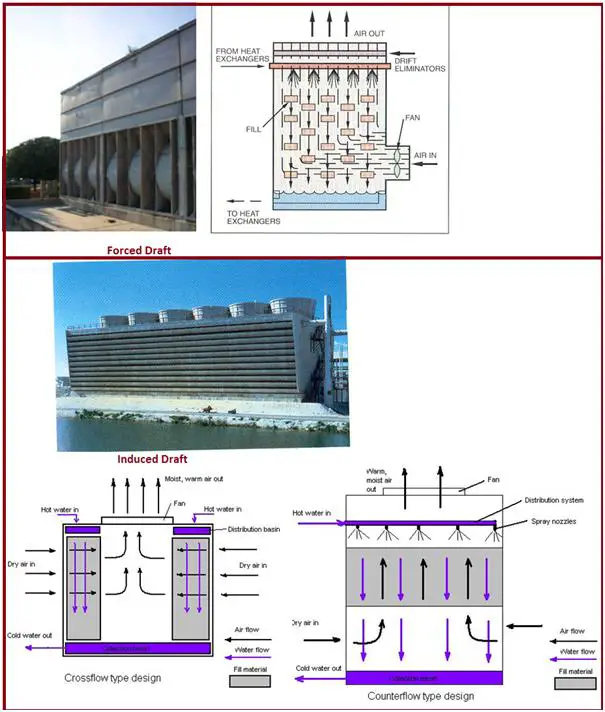
The forced draft is a mechanical draft (Fig. 1) tower
blower type fan at the intake
Fan forces air into the tower, creating high entering and low exiting air velocities.
Induced draft, a mechanical draft tower
with a fan at the discharge which pulls air through the tower
fan induces hot moist air out the discharge
low entering and high exiting air velocities, reducing the possibility of recirculation in which discharged air flows back into the air intake
Two configurations, Cross Flow and Counter Flow
Fig. 1: Mechanical Draft Towers
Cross Flow Induced Draft Cooling Towers
Airflow directed perpendicular to the water flow
Airflow enters one or more vertical faces of the cooling tower to meet the fill material
Air continues through the fill and thus past the water flow into an open plenum area
Water flows (perpendicular to the air) through the fill by gravity
Gravity distributes the water through the nozzles uniformly across the fill material
Counter Flow Induced Draft Cooling Towers
The airflow is directly opposite of the water flow
Airflow first enters an open area beneath the fill media and is then drawn up vertically
The water is sprayed through pressurized nozzles and flows downward through the fill, opposite to the airflow
Advantages of Cross Flow Towers
Low pumping head, lower first cost pumping systems
Lower energy and operating costs
Accepts larger variation in water flow without adverse effect on the water distribution system
Easy maintenance access to distribution nozzles
Low static pressure drop
Reduced drift, less make-up
More air per fan horsepower
Large diameter fans can be used so that fewer cells are required for a given capacity
Due to more fill gap choking is minimized
Cost lower than counterflow
Disadvantages of Cross Flow Towers
Larger footprint
Approach to cooling tower limited to 4 deg C
The icing of louvers during cold weather, Larger louver surface area makes icing more difficult to control
Low-pressure head on the distribution pan may encourage orifice clogging and less water breakup at the spray nozzle
Advantages of Counter Flow Towers
Increased tower height accommodates longer ranges and closer approaches (can be less than 4 deg C)
More efficient use of air due to finer droplet size from pressure sprays
Vertical air movement across the fill allows the coldest water to be in contact with the driest air maximizing tower performance
Disadvantages of Counter Flow Towers
Cost higher than Crossflow tower
Height is more
Increased system pumping head requirements
Increased energy consumption and operating costs
Difficult to inspect and clean distribution nozzles
Requires individual risers for each cell, increasing external piping costs
Fill gap is less so choking is possible
Resistance to upward air travel against the falling water results in higher static pressure loss and a greater fan horsepower than in crossflow towers
Restricted louver area at the base with the high velocity of inlet air increases the fan horsepower
The tendency for uneven distribution of air through the fill with very little movement near the walls and center of the tower
High inlet velocities are liable to suck airborne trash and dirt into the tower
When to choose – Crossflow towers?
To minimize pump head
To minimize pumping and piping first costs
To minimize operating costs
When flow variance is expected from the process
When ease of maintenance is a concern
When to choose – Counterflow towers?
When space (footprint) is a concern
When icing is of extreme concern
When pumping is designed for additional pressure drop
Material Balance of Cooling Towers
A water balance around the entire system is: M = E + B + W (where, E = Evaporation, B = Blowdown and W = Windage losses, in m3/hr)
Evaporation Losses, E = {C X (T1- T2) X Cp} / Hv (where, C = amount of circulating water in m3/hr, T1/T2 = return/supply temperature, Cp = specific heat of water and Hv = latent heat of vaporization of water)
Windage or drift losses, W from large-scale industrial cooling towers, in absence of manufacturer’s data, may be assumed to be:
W = 0.3 to 1.0 percent of C for a natural draft cooling tower without windage drift eliminators
W = 0.1 to 0.3 percent of C for an induced draft cooling tower without windage drift eliminators
W = about 0.005 percent of C (or less) if the cooling tower has windage drift eliminators
Since the evaporated water has no salts, a chloride balance around the system is: M (Xm) = B (Xc) + W (Xc) = Xc (B + W) where, M = Make-up quantity in m3/hr, Xm = concentration of chlorides in make-up water in ppmw and Xc = concentration of chlorides in circulating water in ppmw.
Xc/Xm = Cycles of concentration = ppm chloride in circulating water/ppm chloride in make-up water = M / (B+ W) = M / (M – E) = 1 + { E / (B + W) }
Lower COC means high operating cost due to higher make-up
As the cycles of concentration increase the water may not be able to hold the minerals in solution, once solubility is exceeded, they precipitate and cause fouling in exchangers
Cycles of concentration vary from 3 to 5 depending upon the make-up water quality
Components of a Cooling Tower
Cooling Tower Hot Water distribution system – The collection header and branch headers to the individual cells via flow control valves
Types of pump used – Horizontal Centrifugal, Vertical turbine
Fill, the heat transfer surface, most important component of a cooling tower
The efficiency of the tower depends upon its ability to promote both the maximum contact surface and the maximum contact time between air and water
Two basic types of fill – Splash type and Film type
In crossflow, either type can be applied but in counterflow, through either type can be used but tends toward almost exclusive use of the film fills
Material of Construction of Cooling Towers
Wood: Available, Workable, Low Cost, and Durable.
Metals: Steel, Cast Iron, copper alloys, and aluminum alloys. Special care required for corrosion control for metals other than steel. Used for fan hubs, basins, partitions, fan cylinders, bolts, nuts, washers, gear cases, anchor castings, etc.
Plastics: Capable to be molded into single parts of complex shape and dimensions. Used for fan blades, fan cylinders, fill supports, drift eliminators, louvers, etc.
Concrete: Higher initial cost but decreased fire risk and higher load-carrying capacity.
Special Types of Cooling Towers
Dry Cooling Towers
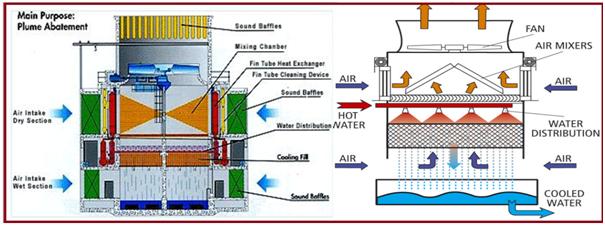
Hybrid Cooling Towers (also called plume abatement towers)
Dry Cooling Towers
Basically an air-cooled heat exchanger
Sensible cooling of water through finned coils
The low temperature of inlet air is essential
Less efficient cooling – large surface areas
Water temperatures higher than evaporative type cooling towers
Hybrid Cooling Towers
Combines both dry and wet sections
Operational flexibility in case of variation in ambient conditions
More effective cooling than dry type towers
Avoids plume formation
Hybrid Cooling Towers-Sub Types
Parallel path tower
Series path tower
Adiabatic air pre-cooler
Parallel Path Towers (Fig. 2):
Coil section located vertically on top of the fill section
Induced draft fan
Hot water flows through the coil and fills section in series
Parallel streams of airflow through the coil and fill sections
Dry and saturated air streams mix in the fan section
Fig. 2: Parallel Path Towers
The ratio of two sections depending on the inlet air characteristics
Supply of air to each section may be adjusted with louvers at the inlet
During low ambient temperatures fill section may be completely isolated
Requires more height of the tower
Series Path Tower:
Air flows through the coil and fills sections in series
Induced draft fan – cross flow
The coil may be before or after fill section
De-saturation of the air stream in the coil section
Less height of tower compared to parallel path towers
Less flexibility of operation on airside
The proximity of the dry coil to fill section leads to:
Impingement
Scaling problems
Restricted airflow.
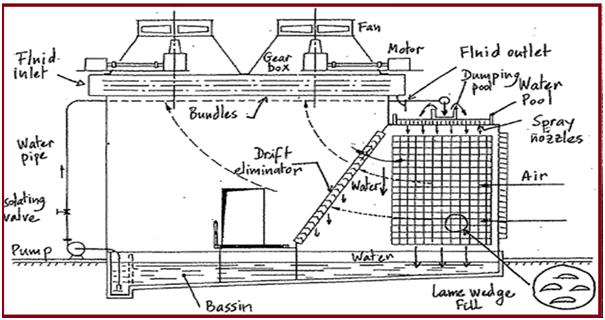
Adiabatic Air Pre-Cooler (Fig. 3):
Also known as a humidified air cooler
Effective for low RH areas
Fill section adjacent to dry section with drift eliminator in between
Finned tube bundle located on top of dry section
The induced draft fan draws air through fill and coil sections in series
Two water streams – closed loop through the coil and open loop through the fill
Fig. 3: Adiabatic Air Pre-Cooler
Water re-circulated infill section
Air, cooled in the fill section, exits in the saturated condition
Process water-cooled in the coil with outlet air from fill section
Air at the outlet of coil section exits at a higher temperature and in unsaturated condition
Water circuit in an open loop can be shut-off during winter
Less impingement
Existing evaporative towers can be retrofitted
Disadvantages:
Two water circuits mean additional accessories and chemical treatment