Recent Posts

What Causes Stresses in A Piping and Pipeline System?

Piping and Pipeline Engineers often talk about pipe stress analysis or pipeline stress analysis which is a dedicated activity performed by stress engineers using some kind of software like Caesar II, Start-Prof, Autopipe, or Rohr-2. But to judge any piping or pipeline system, it is always good to know what is causing that stress in the piping or pipeline system. In this article, we will explain the answer to one of the most basic questions of pipe stress analysis; i.e., What causes the stresses in the pipe?

Classification of Stresses in Piping and Pipeline Systems

Let’s start the discussion by classifying the types of stresses in a piping system. In general, the Stresses generated in piping and pipeline systems can be broadly classified into three categories:

Primary Stresses:

These are stresses that result from external loads, such as internal pressure, dead weight, and external forces. They are generally steady and must be within the allowable limits to prevent failure.

Secondary Stresses:

These arise from displacement-controlled loads, such as thermal expansion or contraction. Secondary stresses are often self-limiting but can cause fatigue over time if not properly managed.

Peak Stresses:

These are localized stresses that occur at points of discontinuity, such as welds, fittings, and supports. Peak stresses are typically higher than the general stress in the system and can lead to crack initiation if not adequately addressed.

What Causes Primary Stresses in a Piping System?

1. Internal Pressure

One of the most significant contributors to stress in a piping system is the internal pressure of the fluid being transported. Internal pressure generates circumferential stress (also known as hoop stress) and longitudinal stress within the pipe wall.

Hoop Stress

This stress acts around the circumference of the pipe and is the result of the internal pressure acting outwards. It is the dominant stress in thin-walled pipes and is given by the formula: 𝜎h=(PD/2T).

Here,

  • 𝜎h is the hoop stress
  • P is the internal pressure
  • D is the outside diameter of the pipe
  • T is the wall thickness of the pipe

Longitudinal Stress

This stress acts along the length of the pipe and is generally lower than the hoop stress. It can be calculated using the formula: 𝜎𝑙=PD/4T.

From the above, it is clear that

  • 𝜎h=2* 𝜎𝑙 which means hoop stress is more significant than longitudinal stress in the piping and pipeline system. In most piping or pipeline design codes, this hoop stress equation is used as the base equation for pipe thickness calculation.
  • Both hoop stress and longitudinal stress are proportional to the internal pressure, which means the generated stresses increase with an increase in pressure.
  • The stress in the piping or pipeline system increases with a decrease in pipe wall thickness (T) which means the stress and thickness are inversely proportional.
  • Also, with an increase in diameter, the generated stresses also increase.

2. External Loads-Weight

The weight load constitutes of the following loads:

  • Self Weight of the Pipe: The weight because of the material’s mass.
  • Liquid Weight: The weight of the amount of liquids that the pipe carries.
  • Insulation Weight: The weight of the insulation material, if any
  • Rigid Body Weights: Weight of Flanges, Valves, or any other rigid bodies.
  • Weight of external attachments.
  • Weight of Snow and Ice.

These loads induce bending stresses and axial stresses in the pipe.

Bending Stresses:

These occur due to the pipe’s weight and any external forces acting on it. The magnitude of the bending stress depends on the pipe’s span length, support conditions, and the distribution of the external loads.

Axial Stresses:

Axial stresses are caused by the pipe’s weight and any external forces acting along its length. They are also influenced by the pipe’s restraint conditions, such as whether it is fixed, anchored, or free to expand and contract.

3. Pressure Transients (Water Hammer)

Pressure transients, often referred to as water hammer or pressure surge, occur when there is a sudden change in the flow rate of the fluid within the pipeline. This can happen due to the rapid closing or opening of valves, pump starts or stops, or sudden changes in demand. The water hammer generates a pressure wave that travels through the pipeline, causing high transient stresses. These types of stresses are known as occasional stresses as they usually occur for very short period of time with respect to the design life of the piping or pipeline system.

Impact of Water Hammer:

The rapid pressure changes can induce severe axial and hoop stresses, which can lead to pipeline rupture, joint failure, or support damage. It is essential to design systems with surge protection devices, such as pressure relief valves and surge tanks, to mitigate the effects of water hammering.

4. Other Occasional Forces

There are various other occasional forces that also contributes to the initiation of pie stress. Some of the notable occasional forces are:

  • Wind Forces
  • Wave forces
  • Accidental forces
  • Reaction forces of sudden PSV/PRV discharge
  • Vibration generated due to
    • High Flow velocities.
    • Acoustic behavior (predominantly in gas systems)
    • Equipment induced vibration
    • Any other external events like vortex shedding, pulsating flow, two-phase flow, etc.

What Causes Secondary Stresses in a Piping or Pipeline System?

1. Thermal Expansion and Contraction

Piping systems are often subjected to temperature variations due to the nature of the fluids they transport or changes in ambient conditions. Thermal expansion and contraction cause the pipe material to expand or contract, leading to secondary stresses.

Thermal Stress:

A change in temperature causes a pipe to expand or contract. This movement can not be contained. This expansion needs to be absorbed. If the pipe can move freely without any restriction, there will not be any stress. However, because of the closed nature of the piping system, free thermal movement without restriction is not allowed. If the pipe deforms with little restriction, a little thermal stress is generated. However, if the pipe is over-constrained, the pipe and supports will experience increased load and stress.

The stress induced by thermal expansion or contraction can be calculated using the formula: σt=E⋅α⋅ΔT

Where,

  • σt is the thermal stress
  • E is the modulus of elasticity of the pipe material
  • α is the coefficient of thermal expansion of the pipe material𝑇
  • ΔT is the temperature change

Thermal stresses are displacement-controlled and can cause significant movement in the piping system, leading to fatigue, stress concentration, and even failure if not adequately accommodated.

2. Thermal Gradient

A thermal gradient occurs when there is a temperature difference across the pipe wall or along the length of the pipe. This can happen in systems where hot and cold fluids are transported simultaneously, or where there are significant temperature differences between different sections of the pipeline.

Thermal Gradient Stresses:

The differential expansion caused by a thermal gradient can induce bending and axial stresses in the pipe. These stresses are particularly problematic in systems with rigid supports or where the pipe material has a low tolerance for thermal stress.

3. Pipeline Settlement and Ground Movement

In buried pipelines, ground movement due to settlement, earthquakes, or landslides can induce secondary stresses. These stresses arise from the differential movement of the pipeline relative to the surrounding soil or rock.

Settlement-Induced Stresses:

Differential settlement can cause bending and axial stresses in the pipeline. These stresses are particularly critical in long pipelines and can lead to buckling or rupture if not properly accounted for.

Seismic-Induced Stresses:

Earthquakes can generate significant ground movement, leading to high bending and axial stresses in pipelines. These stresses are often concentrated at points of restraint, such as bends, tees, and connections to rigid structures.

What Causes Peak Stresses in Pipe?

1. Discontinuities and Stress Concentrations

Peak stresses occur at points of discontinuity in the piping system, such as welds, fittings, flanges, and supports. These discontinuities create stress concentrations that are higher than the general stress in the pipe.

Welded Joints:

Welded joints are common sources of peak stresses due to the mismatch in material properties, geometry, and residual stresses from the welding process. Weld defects, such as cracks, porosity, or lack of fusion, can further exacerbate these stresses and lead to failure.

Fittings:

Fittings create geometric discontinuities that cause stress concentrations. For example, a sudden change in pipe diameter at a reducer fitting can induce peak stresses that are higher than the nominal stress in the pipe.

Supports and Restraints:

Pipe supports and restraints, such as clamps, hangers, and anchors, can create localized stress concentrations. The interaction between the pipe and the support can lead to high contact stresses, which can cause wear, fatigue, and eventually failure.

2. Corrosion and Erosion

Corrosion and erosion are common in piping systems that transport corrosive or abrasive fluids. These processes lead to material loss, which can create localized weak points and stress concentrations.

Corrosion-Induced Stresses:

Corrosion can cause thinning of the pipe wall, leading to a reduction in the pipe’s load-carrying capacity. Localized corrosion, such as pitting, can create stress concentrations that are much higher than the nominal stress in the pipe.

Erosion-Induced Stresses:

Erosion, particularly in high-velocity or turbulent flow conditions, can lead to material loss and the formation of localized pits or grooves. These defects act as stress concentrators, increasing the likelihood of crack initiation and propagation.

3. Fatigue

Fatigue is the progressive and localized structural damage that occurs when a material is subjected to cyclic loading. In piping systems, fatigue can be caused by fluctuating pressure, temperature cycles, and vibration.

Cyclic Loading:

Repeated cycles of loading and unloading, such as pressure fluctuations or thermal cycles, can cause fatigue in the pipe material. The fatigue life of the pipe depends on the magnitude and frequency of the cyclic loads, as well as the presence of stress concentrations.

Vibration-Induced Fatigue:

Vibration, particularly in systems with rotating equipment or turbulent flow, can induce cyclic stresses that lead to fatigue. Vibration-induced fatigue is often concentrated at points of discontinuity, such as welds, fittings, and supports.

Methods for Mitigating Stresses in Piping and Pipeline Systems

Mitigating the stresses in piping and pipeline systems is essential for ensuring their longevity, reliability, and safety. There are several methods and best practices that can be employed to reduce the impact of these stresses:

A. Proper Design and Material Selection

Design Codes and Standards:

Adhering to industry codes and standards, such as ASME B31.3 for process piping or API 1104 for pipeline welding, ensures that the piping system is designed to withstand the expected loads and stresses.

Material Selection:

Choosing the right material for the pipe, considering factors such as strength, toughness, corrosion resistance, and thermal properties, is crucial for minimizing stress-related issues. For example, selecting a material with a high thermal expansion coefficient can help reduce thermal stress in high-temperature applications.

Wall Thickness:

Increasing the wall thickness of the pipe can reduce the hoop stress induced by internal pressure. However, this must be balanced with the need to keep the system economical and manageable in terms of weight and installation.

B. Stress Analysis and Simulation

Finite Element Analysis (FEA):

FEA is a powerful tool for analyzing the stresses in complex piping systems. It allows engineers to simulate various loading conditions, including thermal expansion, pressure transients, and external loads, to identify areas of high stress concentration and potential failure points.

Piping Flexibility Analysis:

Flexibility analysis helps ensure that the piping system can accommodate thermal expansion and contraction without excessive stress. This involves calculating the pipe’s flexibility, considering factors such as support locations, pipe routing, and material properties.

C. Stress Mitigation Techniques

Expansion Loops and Joints:

Incorporating expansion loops or joints into the piping design can help absorb thermal expansion and reduce stress. These components provide the necessary flexibility to accommodate thermal movement without inducing excessive stress on the pipe or its supports.

Proper Support Design:

Properly designed and placed supports are critical for minimizing stresses in piping systems. Supports should be positioned to prevent excessive sagging, bending, and axial movement. Additionally, using spring supports or hangers can help accommodate thermal expansion and contraction.

Surge Protection:

Installing surge protection devices, such as pressure relief valves or surge tanks, can help mitigate the effects of pressure transients (water hammer). These devices absorb the energy of pressure waves, reducing the stress on the piping system.

D. Regular Inspection and Maintenance

Non-Destructive Testing (NDT):

Regular NDT, such as ultrasonic testing, radiographic testing, and magnetic particle testing, can help identify areas of stress concentration, corrosion, or fatigue before they lead to failure.

Corrosion Protection:

Applying protective coatings, using corrosion inhibitors, and implementing cathodic protection systems can help mitigate corrosion-induced stresses, extending the life of the piping system.

Fatigue Monitoring:

Implementing fatigue monitoring techniques, such as vibration analysis and thermal cycle monitoring, can help detect early signs of fatigue and allow for timely maintenance or replacement of affected components.

On a broader view, the following can be introduced to reduced stresses generated in a piping system:

  • To reduce pressure stresses, increase the pipe thickness, if economically feasible.
  • To reduce weight stress, add more support by reducing the support span.
  • To reduce expansion stresses, add more flexibility to the system.
  • To reduce occasional stresses, add more guides and axial stops in the piping system
  • To reduce vibrational stresses, increase the system rigidity by adding supports.

Online Courses on Pipe Stress Analysis

If you are looking for an online course to learn pipe stress analysis then visit the following:
Complete Pipe Stress Analysis using Caesar II Online Course

Differences Between Piping Wall Thickness and Pipeline Wall Thickness

While “piping” and “pipeline” may sound similar, they refer to different applications and contexts within the broader field of fluid transportation. This distinction affects how wall thickness is considered for each. Here’s a breakdown of the differences between piping wall thickness and pipeline wall thickness:

1. Context and Application

  • Piping Wall Thickness:
    • Context: Piping typically refers to systems used within facilities such as refineries, chemical plants, power plants, and other industrial settings. These systems transport fluids and gases over short distances within a controlled environment.
    • Application: Piping systems are used for processes, utilities, and distribution within a plant. They often involve complex networks with numerous fittings, valves, and pressure vessels.
  • Pipeline Wall Thickness:
    • Context: Pipelines refer to long-distance transportation systems, often spanning hundreds or thousands of kilometers, and are used to transport oil, gas, water, or other fluids between different locations, such as from a production site to a refinery or from a water treatment plant to a city.
    • Application: Pipelines are used for transporting fluids across large geographical areas, typically underground or underwater, with minimal intervention between the start and endpoints.

2. Design Standards and Codes

  • Piping Wall Thickness:
    • Design Codes: Piping wall thickness is usually governed by standards such as ASME B31.3 (Process Piping), ASME B31.1 (Power Piping), or API 570 (Piping Inspection Code). These standards provide guidelines for calculating wall thickness based on internal pressure, material, temperature, and other factors.
    • Thickness Consideration: In piping systems, wall thickness is often designed to handle higher pressure differentials, due to the more complex internal flow paths, higher temperatures, and diverse fluid properties.
  • Pipeline Wall Thickness:
    • Design Codes: Pipeline wall thickness is generally governed by standards such as ASME B31.4 (Pipeline Transportation Systems for Liquid Hydrocarbons and Other Liquids), ASME B31.8 (Gas Transmission and Distribution Piping Systems), or API 5L (Specification for Line Pipe).
    • Thickness Consideration: For pipelines, wall thickness is more influenced by external factors such as ground conditions, potential mechanical impacts (e.g., from excavation equipment), human occupancy, and long-term environmental exposure. The design must ensure the pipeline can withstand the pressure over long distances with minimal maintenance.

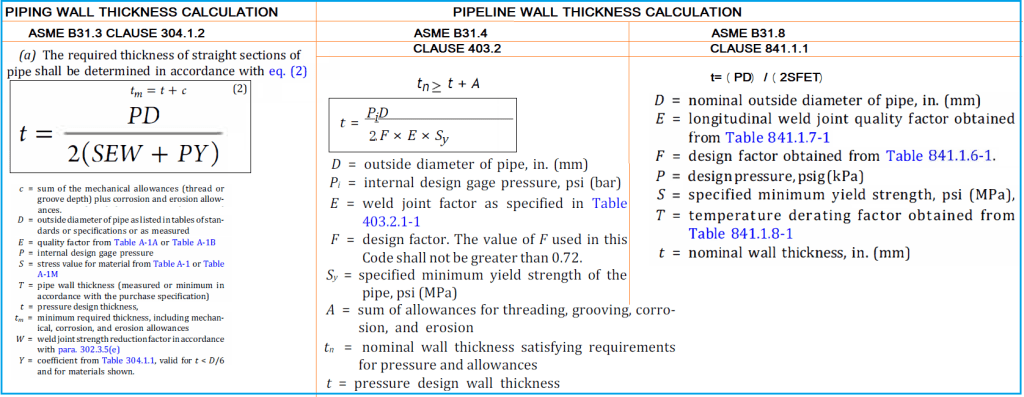
3. Piping and Pipeline Wall Thickness Calculation Equation

The pipe wall thickness calculation for piping and pipeline systems is provided in Fig. 1 below:

Piping vs Pipeline Thickness Calculation Equation
Fig. 1: Piping vs Pipeline Thickness Calculation Equation

To learn more about piping wall thickness calculation visit Pipe Thickness Calculation as per ASME B31.3 | Pipe Thickness Calculator and Pipe Thickness Calculation of Straight Pipe under External Pressure/ Vacuum Pressure Condition. However to know the steps for pipeline wall thickness calculation visit Steel Pipeline Wall Thickness Calculation With Example and Steps for Pipeline Wall Thickness Calculation with Case Study.

4. Pressure Considerations

  • Piping Wall Thickness:
    • Pressure Levels: Piping systems within facilities typically handle a wide range of pressures, including very high pressures, depending on the process requirements. Therefore, the wall thickness is often calculated with higher precision to manage these variable pressures.
    • Pressure Drop: Piping systems experience more frequent pressure drops due to the complexity of the network, with numerous bends, valves, and fittings. This variability in pressure requires careful consideration of wall thickness.
  • Pipeline Wall Thickness:
    • Pressure Levels: Pipelines generally operate under a more consistent pressure, which is determined by the distance and the elevation changes along the pipeline route. The wall thickness is designed to manage the steady state pressure over long distances, ensuring durability and integrity.
    • Pressure Drop: Pressure drop in pipelines is usually managed over long distances using booster stations. The wall thickness is selected to handle the maximum pressure expected in the system, considering factors like terrain elevation and flow rate.

5. Piping and Pipeline Thickness Values

Piping thicknesses after calculating the minimum required thickness are always selected from ASME B36.10 or ASME B36.19. So, all pipe thicknesses in the piping industry are mostly standard thicknesses (Also known as pipe schedules). However, as pipelines run for several kilometers, tonnage cost matters a lot. In this respect to reduce cost, pipeline thickness is selected as a non-standardized value. For example, let’s assume in your pipe thickness calculation, you got the calculated thickness as 4.8 mm for an 8″ pipe size. In general, for a piping system the selected thickness will be 8″, Sch 20 means 6.35 mm whereas for pipeline system the selected pipe wall thickness will be 4.8 mm.

6. Material and Corrosion Allowance

  • Piping Wall Thickness:
    • Material: Piping systems often use a wider range of materials, including carbon steel, stainless steel, alloy steel, and non-metallic materials like PVC or HDPE. The choice of material influences the wall thickness, especially when dealing with corrosive or high-temperature environments.
    • Corrosion Allowance: In industrial settings, where pipes may be exposed to harsh chemicals or corrosive fluids, a significant corrosion allowance may be added to the wall thickness. This ensures that the pipe remains safe over its expected service life, even as it experiences material degradation.
  • Pipeline Wall Thickness:
    • Material: Pipelines are predominantly constructed from carbon steel, with specialized coatings and cathodic protection systems to prevent corrosion over long distances. Material selection is crucial for managing both internal corrosion (from the fluid being transported) and external corrosion (from the environment).
    • Corrosion Allowance: For pipelines, the corrosion allowance is often integrated into the initial design, with additional protective measures like coatings and cathodic protection to ensure longevity. The wall thickness must be sufficient to last for decades with minimal maintenance.

7. Environmental and Mechanical Loads

  • Piping Wall Thickness:
    • Environmental Loads: Piping within facilities is generally protected from environmental conditions like extreme temperatures, UV radiation, and mechanical impacts. However, thermal expansion, vibration, and support loads are critical considerations.
    • Mechanical Loads: Piping systems must account for mechanical loads from supports, thermal expansion, and vibration. These loads can influence the required wall thickness, especially in high-stress areas like bends or connections to equipment.
  • Pipeline Wall Thickness:
    • Environmental Loads: Pipelines are exposed to a variety of environmental conditions, including temperature extremes, soil movement, and potential mechanical impacts from external sources (e.g., digging, landslides). The wall thickness is often designed to withstand these external threats.
    • Mechanical Loads: In addition to internal pressure, pipelines must withstand mechanical loads from ground movement, external impacts, and installation processes. This requires a robust wall thickness to prevent failures in harsh environments.

8. Inspection and Maintenance

  • Piping Wall Thickness:
    • Inspection: Piping systems within facilities are regularly inspected, with wall thickness measurements taken periodically to assess corrosion and wear. This frequent inspection allows for adjustments or replacements before significant failures occur.
    • Maintenance: Maintenance in piping systems is more frequent and accessible, given the proximity and accessibility within industrial plants. Wall thickness considerations must account for the ease of repair or replacement.
  • Pipeline Wall Thickness:
    • Inspection: Pipelines, due to their length and remote locations, are inspected using methods like pigging (pipeline inspection gauges) and remote sensing technologies. Wall thickness is designed to minimize the need for frequent inspections.
    • Maintenance: Pipeline maintenance is more challenging and costly due to the remote and inaccessible nature of many pipeline routes. As such, the wall thickness must be designed for long-term reliability with minimal intervention.

Piping and Pipeline Diameter Chart

The following table provides a piping and pipeline diameter chart. Note that, the outside diameter (OD) of steel pipe in piping and pipeline applications is constant for the same pipe size. However, the Internal diameter will vary depending on the thickness. To give an example, the OD of a 10″ steel pipe will be 273.05 mm whether it is used in a piping or pipeline application.

Sr NoPipe Nominal Size (NPS)Pipe Outer Diameter (mm)Pipe Outer Diameter (inches)
11/221.340.84
23/426.671.05
3133.401.32
41 1/442.161.66
51 1/248.261.90
6260.332.37
72 1/273.032.87
8388.903.50
93 1/2101.604.00
104114.304.50
115141.305.56
126168.286.63
138219.088.63
1410273.0510.75
1512323.8512.75
1614355.6014.00
1716406.4016.00
1818457.2018.00
1920508.0020.00
2022558.8022.00
2124609.6024.00
2226660.4026.00
2328711.2028.00
2430762.0030.00
2532812.8032.00
2634863.6034.00
2736914.4036.00
2838965.2038.00
29401016.0040.00
30421066.8042.00
31441117.6044.00
32461168.4046.00
33481219.2048.00
34501270.0050.00
35521320.8052.00
36541371.6054.00
37561422.4056.00
38581473.2058.00
39601524.0060.00
Table 1: Pipeline Diameter Chart

This table provides the nominal pipe sizes (NPS), and the corresponding outer diameters in both millimeters and inches for steel pipes ranging from 1/2 inch to 60 inches.

In summary, the differences between piping wall thickness and pipeline wall thickness stem from their distinct applications, operating conditions, design codes, and design requirements. While both are critical for ensuring the safety and integrity of fluid transport systems, the considerations for each are tailored to the specific challenges and environments they face. Understanding these differences is essential for engineers and designers to select the appropriate wall thickness for their specific needs.

Vertical Pipe Support | Supporting Vertical Pipes

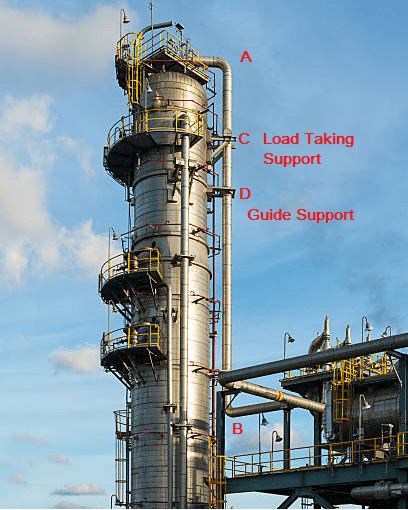
Many times, you will find the piping geometry to run in the vertical direction. A typical example could be the Column or Tower piping (Refer to Fig. 1). From the overhead nozzle, the pipe runs vertically downward for a certain stretch until it reaches the pipe rack location. In such cases, the supporting of vertical piping runs may seem to be very difficult. For the specific example, the pipe is usually supported using cleat or clip supports from the equipment itself. Similar types of vertical runs of pipe can occur in many different locations. In this article, we will describe some of the vertical pipe supports to understand the supporting philosophy for such pipes.

What is a Vertical Pipe Support?

In the complex world of piping systems, support mechanisms play a pivotal role in ensuring structural integrity, operational efficiency, and safety. Vertical pipe supports are crucial in maintaining the stability and alignment of piping that runs vertically, either within industrial facilities.

Vertical pipe support refers to the system or method used to stabilize and hold vertical piping in place within a structure. These supports are essential for preventing the pipe from buckling, swaying, or experiencing undue stress due to the weight of the fluid or gases they transport, as well as external forces like wind or seismic activity. They are particularly critical in high-rise equipment like reactors, distillation columns, towers, and other structures where extensive vertical piping systems are present.

The primary goal of vertical pipe support is to ensure that the piping remains in its designated position without shifting, bending, or being subject to excessive loads. This, in turn, helps to prevent leaks, breaks, or other failures that could lead to operational downtime, costly repairs, or even catastrophic events.

Types of Vertical Pipe Supports

Vertical pipe supports used in the oil and gas industries can be classified into the following groups:

  • Load Carrying Supports to Carry the Pipe and Content Weight
  • Guide supports to restrict the pipe’s sideway movement, and
  • Axial Stop supports for restricting the pipe movement in the axial direction.

Let’s understand the types of vertical pipe supports with some examples.

Vertical Pipe Support in Column Piping
Fig. 1: Vertical Pipe Support in Column Piping

In Fig. 1, the supporting of a typical distillation column piping is shown. The Stretch A to B is a vertical run of the pipe. We can not support the pipe run near point B as that will cause uneven thermal movement at the nozzle due to the piping side and equipment side thermal growth. At the same time, the weight of the vertical run of the pipe must be transferred from the nozzle by providing load-carrying support. It is, therefore, supported at point C using trunnions (dummy) from the vertical pipe and resting those at the equipment cleats. Again at point D the pipe is supported using Guide Supports from the equipment clips.

Load-Taking Vertical Pipe Supports

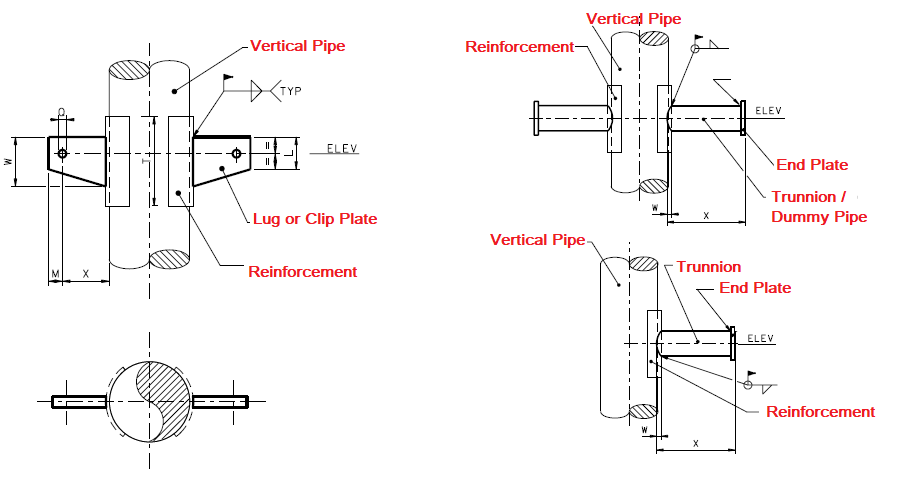
Load-carrying vertical pipe supports can be installed by welding Lugs or Trunnions on the vertical Pipe as shown in Fig. 2 below.

Support on Vertical Pipes
Fig. 2: Support on Vertical Pipes

This type of support is known as Rest support for vertical pipes.

Guide Support on Vertical Pipes

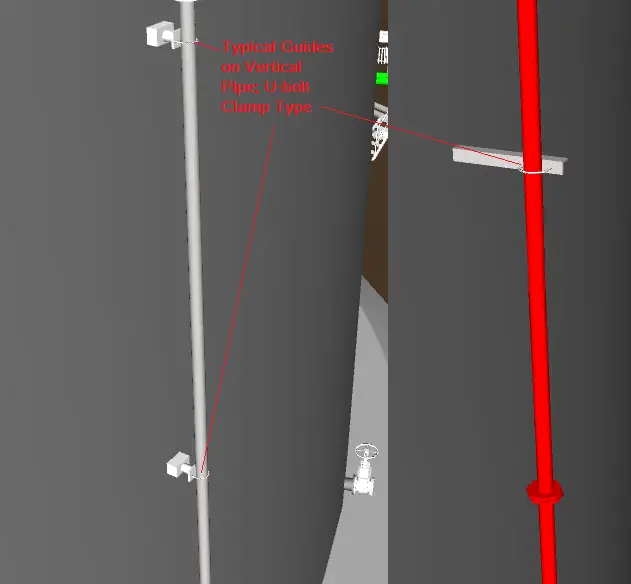
The guide supports on vertical pipe restrict sideway movements. Refer to Fig. 3 below which shows a typical example of vertical pipe guide support. This type of support is known as all-around guide support.

Guide Support on Vertical Pipes
Fig. 3: Guide to Vertical Pipes

Hold-down supports with pipe shoes, if installed in the vertical pipe will also act as all-around guide support.

Axial Stops on Vertical Pipes

Axial Stops or Limit Stops on vertical pipe restrict the axial movement of the vertical pipe. As the pipe run is in the vertical direction so here the axial stop will restrict the movement in vertical direction. Also, it carries the piping load. If the same trunnion support as shown in Fig. 2 is clamped on the structure, it will act as an axial stop support. By default, due to the trunnion over structure, the pipe is not able to move in the downward direction. Again, when clamped it will not be able to move in the vertically upward direction. So, in both directions, upward and downward movement is locked at the support location which is the characteristic of axial stop support.

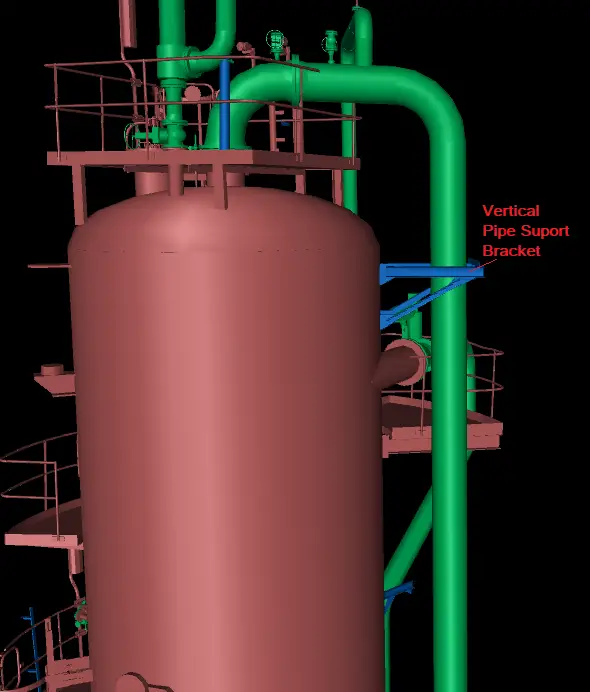
Vertical Pipe Support Bracket

A vertical pipe support bracket is a structural element designed to hold, guide, and support vertical piping. These brackets are typically attached to walls, ceilings, or other structural elements, providing a secure point of support that prevents pipes from shifting, sagging, or becoming misaligned due to gravity, thermal expansion, or external forces. Fig. 4 shows a typical vertical pipe support bracket.

Vertical Pipe Support Bracket
Fig. 4: Vertical Pipe Support Bracket

Types of Vertical Pipe Support Brackets

There are various types of vertical pipe support brackets, each designed for specific applications and requirements:

a) Wall-Mounted Brackets

Wall-mounted brackets are commonly used in scenarios where vertical pipes run along or are close to a wall. These brackets can be made from different materials such as steel, stainless steel, or aluminum, and are typically bolted or welded to the wall.

Applications: Ideal for indoor installations in residential, commercial, and industrial buildings.

b) Ceiling-Mounted Brackets

These brackets are used when pipes are suspended from the ceiling. They typically feature a clamp or cradle that secures the pipe while being attached to a ceiling-mounted anchor point.

Applications: Commonly used in commercial buildings, factories, and facilities where pipes need to be kept off the floor or away from walls.

c) Floor-Mounted Brackets

Floor-mounted brackets, or pipe stands, are used to support vertical pipes that extend from the floor. These brackets are often adjustable and can handle a significant amount of weight.

Applications: Suitable for industrial settings where pipes are required to rise vertically from machinery, tanks, or other ground-level equipment.

d) Adjustable Brackets

Adjustable brackets provide installation flexibility. They allow for fine-tuning the pipe’s position during or after installation, which is particularly useful in systems where precision alignment is crucial.

Applications: Used in custom installations or where piping may need to be adjusted after the initial installation due to settling or realignment.

e) Anchor Brackets

Anchor brackets are designed to hold the pipe rigidly in place, preventing any movement. These are critical in sections of the piping system where movement could lead to misalignment or damage.

Applications: Often used in seismic zones or where the pipe is subject to dynamic forces, such as in high-pressure systems.

Guide to Corrosion Inhibitors in the Oil and Gas Industry

The oil and gas industry plays a pivotal role in the global economy, supplying the energy needed to power industries, homes, and transportation systems worldwide. However, the infrastructure supporting this industry, including pipelines, storage tanks, and processing facilities, is subject to a persistent and costly problem: corrosion. Corrosion, the gradual degradation of materials (usually metals) through chemical reactions with their environment, poses a significant threat to the safety, efficiency, and economic viability of oil and gas operations. Corrosion inhibitors, substances that mitigate or prevent corrosion, are therefore essential to maintaining the integrity and longevity of oil and gas infrastructure. In this article, we will learn about corrosion inhibitors in detail.

What are Corrosion Inhibitors?

Corrosion inhibitors are chemical compounds that are added in very low concentrations to the flowing fluids (additives to the fluids) to significantly reduce the material corrosion rate. These corrosion inhibitors form a passive layer on the metal surface so the metal does not directly come in contact with the corrosive fluid. Depending on fluid composition, the quantity of water, and the fluid flow regime, the effectiveness of a corrosion inhibitor varies. To reduce the risk of corrosion in metals, corrosion inhibitors are widely used in the industry. Inhibitors are organic or inorganic compounds and are usually dissolved in aqueous environments. They are available in spray form in combination with a lubricant and sometimes a penetrating oil. However, they can be solids, liquids, or gases. Concentrations of corrosion inhibitors in the corrosive fluid vary from 1 to 15,000 ppm (0.0001 to 1.5 wt %).

In oil and gas exploration and production, chemical & petrochemical industries, petroleum refineries, water treatment industries, heavy manufacturing, and product additive industries, corrosion inhibitors are considered the first line of defense. Corrosion Inhibitors do not react with the fluid and can be applied in situ without causing any significant disruption to the process. To decrease the corrosion rate, Corrosion inhibitors affect any one of the four components of a corrosion cell (anode, cathode, electrolyte, and electronic conductor). The main mechanism on which most corrosion inhibitors work is adsorption.

Types Of Corrosion Inhibitors

Corrosion inhibitors can be classified based on the working mechanism, environment, and operating mode.

A. Depending on the mechanism or electrode process, corrosion inhibitors are classified as follows:

  • Anodic Inhibitor
  • Cathodic Inhibitors, and
  • Mixed Inhibitors.

A.1: Anodic Inhibitors

Anodic inhibitors work by forming a protective oxide film on the metal surface, which reduces the anodic reaction (oxidation of the metal). Common anodic inhibitors include chromates, nitrites, and phosphates. These inhibitors are particularly effective in environments where oxygen is present, such as in cooling water systems.

  • Chromates: Effective but toxic and environmentally hazardous.
  • Phosphates: Commonly used in water treatment applications.

A.2: Cathodic Inhibitors

Cathodic inhibitors function by decreasing the reduction reactions (such as the reduction of oxygen) on the metal surface. Examples include compounds containing zinc and magnesium, which can form insoluble hydroxides that deposit on the metal surface, thus blocking cathodic sites.

  • Bicarbonates: They can reduce corrosion rates in specific environments.
  • Alkaline Substances: These raise the pH of the environment, which can slow down corrosion.

A.3: Mixed Inhibitors

Mixed inhibitors affect both anodic and cathodic reactions. They provide comprehensive protection by forming a film on the metal surface that impedes both oxidation and reduction processes. Commonly mixed inhibitors include amines and silicates.

  • Amine-Based Inhibitors: Widely used in oilfield applications due to their effectiveness in both acidic and neutral environments.
  • Imidazolines: Organic compounds that can provide robust protection against corrosion.

B. Based on the environment, corrosion inhibitors are of the following types:

  • Acidic environment inhibitors
  • Inorganic inhibitors (Example: As2O3, Sb2O3)
  • Organic inhibitors (Example: amines, aldehydes, alkaloids, nitro, and nitroso compounds)
  • Alkaline inhibitors (Examples: thiourea, substituted phenols, naphthol, β-diketone, etc.)
  • Neutral inhibitors

C. Depending on the protection mode, the following types of corrosion inhibitors are found:

  • Chemical passivation (Nitrites, Chromates, Zinc molybdate, etc)
  • Adsorption inhibitors (quinolines, sulfur atoms in these compounds, nitrogen atoms in amines, and oxygen atoms in aldehydes)
  • Film-forming inhibitors (Zinc and calcium salts, Benzoate, etc)
  • Vapor phase corrosion inhibitors (Dicyclohexylamine chromate, benzotriazole, Phenyl thiourea, cyclohexylamine, dicyclohexylamine nitrite, etc.)
  • Volatile corrosion inhibitors (Molybdenum oxide, salts of dicyclohexylamine, cyclohexylamine, and hexamethylene amine)
  • Synergistic inhibitors (chromate-phosphates, polyphosphate-silicate, zinc-tannins, and zinc-phosphates)
  • Precipitation inhibitors (Sodium silicate)
  • Green corrosion inhibitors (Amino acids, alkaloids, pigments, and tannins)

Working Mechanism of Corrosion Inhibitor

Corrosion inhibitors work through various mechanisms, depending on their chemical nature and the type of corrosion they are designed to prevent. The primary mechanisms include:

  1. Adsorption: Many inhibitors adsorb onto the metal surface, forming a protective barrier that prevents corrosive agents from reaching the metal.
  2. Film Formation: Some inhibitors promote the formation of a stable, insoluble film on the metal surface, which acts as a physical barrier.
  3. Passivation: Anodic inhibitors can enhance the formation of a passive oxide layer on the metal, which reduces the rate of metal dissolution.
  4. Precipitation: Certain cathodic inhibitors can induce the precipitation of insoluble compounds that coat the metal surface and inhibit further corrosion.

In the following paragraphs, we will explore the Corrosion Inhibitor Selection for Oil & Gas Industry.

Sources of Corrosion for Oil & Gas Industries

Normally corrosion occurs in the water phase. The major sources of corrosion in the oil and gas industries are:

  • Hydrogen sulfide: sulfide stress corrosion cracking (SSCC)
  • Chloride: chloride stress corrosion cracking (CSCC)
  • Carbon dioxide: Sweet corrosion.
  • Oxygen: pits
  • Bacteria: Microbiologically-influenced corrosion (MIC)
  • Water Cut
  • Strong Acids: hydrofluoric acid and hydrochloric or acetic acids for sandstone and carbonates, respectively, which can cause corrosion of production tubing, downhole tools, and casing
  • Brines: In the presence of dissolved oxygen, act as corrosive.

Corrosion Inhibitor Selection Consideration

  • The use of Corrosion Inhibitors (CI) as an alternative to CRA shall be decided in the earliest design stage based on ILSS, fluid corrosivity, total CAPEX & OPEX, and assumed efficiency & availability.
  • ILSS based on BP, Intertek, and DNV research, values below 2.5 indicate CI likely successful with below 50 ppm, and a value above 5.5 is usually not feasible, CI likely requires a very high dosage and high-reliability injection package.
  • Organic film-forming corrosion inhibitors’ efficiency is reduced in the presence of bacteria, oxygen, and scales. Hence, Compatibility with other chemical treatment and injection strategies shall be studied.
  • Continuous, batch, or squeeze treatments are predicted to contain high concentrations of water. Batch treatment tends to be used in non-severe applications when continuous treatment is technically difficult or when additional protection is required for severe conditions.
  • The chemical fluid analysis shall consist of temperature, pressure, flow rate, sand, CO2, H2S, Chloride, O2, pH, cation & anion, organic acids, bacteria, and viscosity.
  • Failure risk and environmental policy & disposal must be addressed.
  • The possible impact on downstream processes shall be studied.
  • Corrosion inhibitors shall not be used as a primary option to mitigate cracking.
  • High water cuts, velocity, temperature, presence of solids, and pre-existing corrosion have a negative impact on the effectiveness of corrosion inhibitors and require higher concentration.
  • To comply with the environmental standard, rigorous test qualification, high-temperature stability, and long-term degradation, the use of green corrosion inhibitors from organic matter are increasing.

Probable issues with Corrosion Inhibitor Consideration

Corrosion Inhibitor is used in the oil & gas industry by continuous treatment via annulus or small tubing, batch treatment, tubing displacement, and squeeze treatment by adsorbing. In gas lift wells CI is introduced with the gas.

  • Possible issues for continuous treatment via annulus: flashing & gunking, slugging, valve plugging, CI degradation, etc.
  • Possible issues for continuous treatment via tubing: damage risk to injection line during installation, additional cost for accessories & wellhead modification, etc.
  • Possible issues for batch treatment: Corrosion can occur between treatments, wells are taken off production for several hours, many wasted chemicals on restarting the well, and stable emulsions may form.
  • Possible issues for squeeze treatment: expensive, may damage formation, wasted chemical, etc.
  • Special corrosion inhibitor types and injection methods are required for acidizing or fracturing treatments.

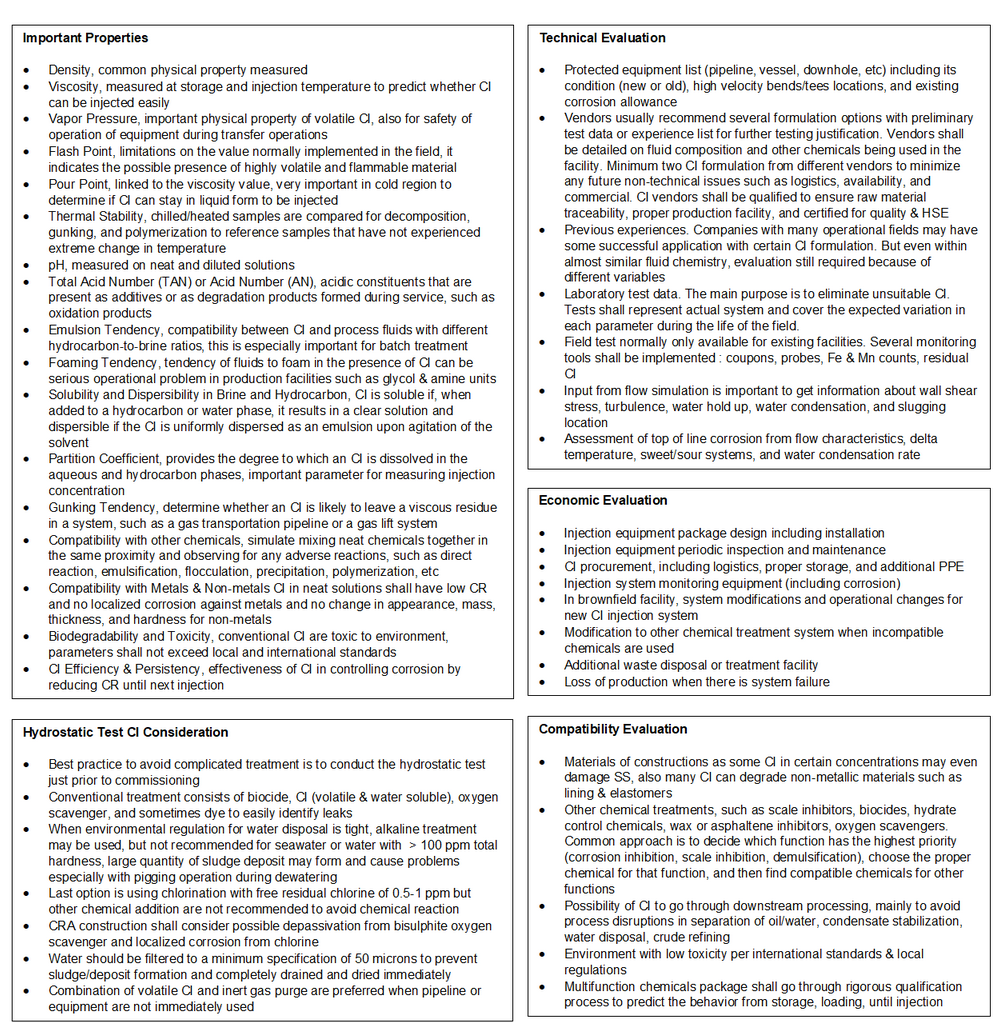
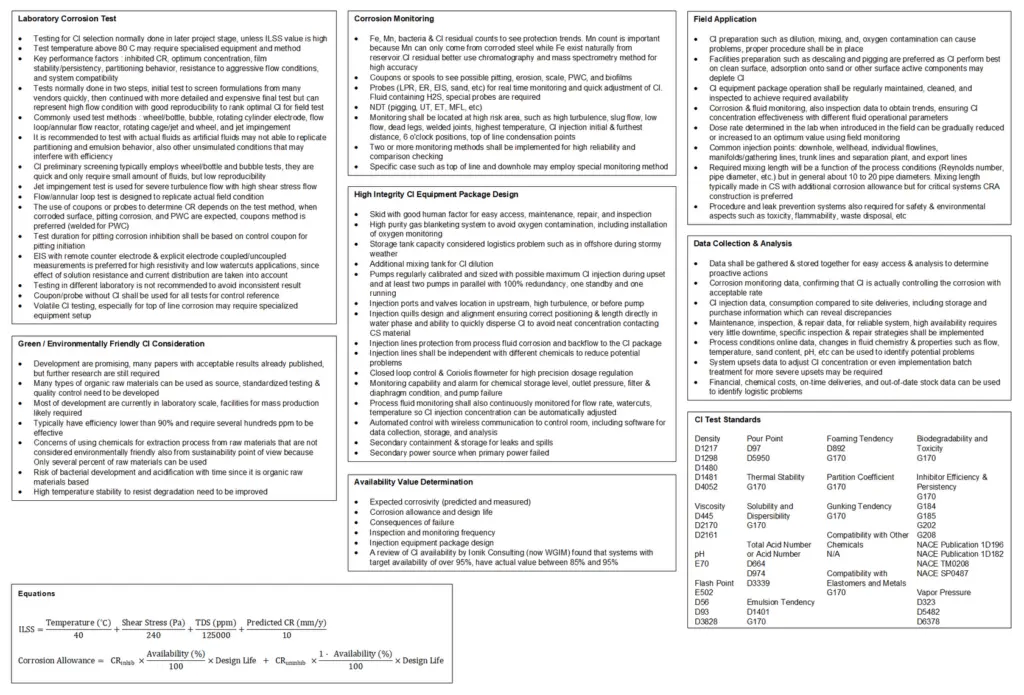
The following images provide more guidelines about the corrosion inhibitors in the oil & gas industry.

Properties of Corrosion Inhibitors
Corrosion inhibitors

Applications of Corrosion Inhibitors in the Oil and Gas Industry

Corrosion inhibitors are used extensively in various sectors of the oil and gas industry, including:

1. Production Wells

In production wells, corrosion inhibitors are injected into the wellbore to protect tubing and casing from the corrosive effects of CO2, H2S, and chloride ions present in the produced fluids.

2. Pipelines

Pipelines transporting crude oil, natural gas, and refined products are susceptible to internal and external corrosion. Corrosion inhibitors are added to the pipeline fluids to protect the internal surfaces, while external coatings and cathodic protection are used for external corrosion control.

3. Storage Tanks

Storage tanks for crude oil and refined products are vulnerable to corrosion, especially at the oil-water interface. Corrosion inhibitors are often added to the stored product to protect the internal surfaces of the tanks.

4. Refineries

In refineries, corrosion inhibitors are used to protect equipment such as distillation columns, heat exchangers, and reactors from corrosive process streams containing sulfur compounds, acids, and salts.

5. Offshore Platforms

Offshore platforms face severe corrosion challenges due to the harsh marine environment. Corrosion inhibitors are used in combination with protective coatings and cathodic protection systems to safeguard structural components and equipment.

6. Downhole Equipment

Downhole equipment, including pumps and casing, is frequently exposed to corrosive substances like hydrogen sulfide (H₂S) and carbon dioxide (CO₂). Specific inhibitors can be tailored for these conditions to protect equipment integrity.

List of Corrosion Inhibitors

Here’s a table summarizing the names of corrosion inhibitors commonly used in the oil and gas industry, categorized by their type:

Type of InhibitorExamples
Anodic InhibitorsChromates
Phosphates
Zinc Compounds
Cathodic InhibitorsSodium Nitrite
Bicarbonates
Alkaline Substances
Mixed InhibitorsAmine-Based Inhibitors
Imidazolines
Cationic Surfactants
Volatile Corrosion InhibitorsBenzotriazole
Octadecylamine
Sodium Vapor Corrosion Inhibitors
Green InhibitorsPlant Extracts (e.g., Neem, Rosemary)
Chitosan
Tannin Extracts
Specialty InhibitorsH₂S Scavengers
Biocides with Corrosion Inhibitory Properties
Coating SystemsEpoxy Coatings
Polyurethane Coatings
Zinc-Rich Primers
Table 1: List of Corrosion Inhibitors

This table provides a clear overview of various corrosion inhibitors used in the oil and gas industry, making it easier to identify and categorize them based on their type and application.

Corrosion inhibitors are essential tools in the oil and gas industry, protecting valuable infrastructure and ensuring operational efficiency. Understanding the types, mechanisms, and applications of these inhibitors is crucial for effective corrosion management.

Frequently Asked Question-Corrosion Inhibitors

1. What are corrosion inhibitors?

Corrosion inhibitors are chemical compounds that, when added to a corrosive environment, significantly reduce the corrosion rate of metals. They work by forming protective layers, altering electrochemical reactions, or passivating metal surfaces.

2. How do corrosion inhibitors work?

Corrosion inhibitors function through various mechanisms, including:

  • Film Formation: They create a protective barrier on the metal surface.
  • Electrochemical Control: They modify the rates of anodic and cathodic reactions.
  • Surface Passivation: They promote the formation of passive films that protect the metal from further corrosion.

3. What types of corrosion inhibitors are available?

Corrosion inhibitors can be classified into several categories:

  • Anodic Inhibitors: Form protective oxide layers.
  • Cathodic Inhibitors: Modify electrochemical reactions at the cathode.
  • Mixed Inhibitors: Provide both anodic and cathodic protection.
  • Volatile Corrosion Inhibitors (VCIs): Vaporize and condense on metal surfaces.
  • Green Inhibitors: Derived from natural sources and environmentally friendly.

4. Where are corrosion inhibitors commonly used in the oil and gas industry?

Corrosion inhibitors are widely used in various applications, including:

  • Pipeline Protection: To prevent corrosion from soil and water.
  • Downhole Equipment: To protect against corrosive substances like H₂S and CO₂.
  • Refineries and Processing Facilities: To maintain the integrity of reactors and heat exchangers.
  • Offshore Platforms: To withstand harsh marine environments.

5. Are there environmental concerns associated with corrosion inhibitors?

Yes, some traditional corrosion inhibitors, like chromates, are toxic and pose environmental hazards. This has led to stricter regulations and a growing focus on developing green inhibitors that are less harmful to the environment.

6. How do I choose the right corrosion inhibitor for my application?

Choosing the right corrosion inhibitor involves:

  • Understanding the Environment: Analyze the specific corrosive agents and conditions (pH, temperature, humidity).
  • Compatibility: Ensure compatibility with the materials used in your equipment.
  • Regulatory Compliance: Consider any environmental regulations that may affect your choice.

7. What are the costs associated with using corrosion inhibitors?

While the initial cost of high-quality corrosion inhibitors can be significant, they often lead to substantial savings by preventing costly failures and extending the lifespan of equipment. A cost-benefit analysis can help determine the most economical solution.

8. Can corrosion inhibitors be used in combination?

Yes, in some cases, corrosion inhibitors can be used in combination to enhance their protective effects. However, it’s essential to ensure that the combined products are compatible and do not counteract each other’s effectiveness.

9. How can I monitor the effectiveness of corrosion inhibitors?

Effectiveness can be monitored through:

  • Regular Inspections: Visual and instrumental inspections of equipment.
  • Corrosion Rate Measurements: Utilizing tools like corrosion probes.
  • Chemical Analysis: Testing for the presence and concentration of inhibitors.

10. What are examples of corrosion inhibitors?

Corrosion inhibitors come in various types, each suited for different applications. Here are some common examples:

Anodic Inhibitors

  • Chromates: Effective in forming protective oxide layers, but environmentally hazardous.
  • Phosphates: Commonly used in water treatment and industrial applications.

Cathodic Inhibitors

  • Bicarbonates: Help reduce corrosion rates in certain environments.
  • Sodium Nitrite: Often used in cooling water systems to protect ferrous metals.

Mixed Inhibitors

  • Amine-Based Inhibitors: Effective in both acidic and neutral environments, frequently used in oilfield applications.
  • Imidazolines: Organic compounds that offer protection in various industrial applications.

Volatile Corrosion Inhibitors (VCIs)

  • Benzotriazole: Used to protect metals in enclosed spaces by vaporizing and forming a protective layer.
  • Octadecylamine: A common VCI for protecting equipment during storage.

Green Inhibitors

  • Plant Extracts: Natural extracts, such as those from neem or rosemary, can provide effective corrosion inhibition.
  • Chitosan: A biopolymer derived from chitin, known for its biodegradable and non-toxic properties.

11. What is the difference between rust inhibitor and corrosion inhibitor?

A rust inhibitor specifically targets the prevention of rust, which is the corrosion of iron and its alloys, typically in the presence of moisture and oxygen. In contrast, a corrosion inhibitor is a broader term that encompasses a range of chemicals designed to reduce corrosion in various metals, not just iron, across different environmental conditions. While all rust inhibitors can be classified as corrosion inhibitors, not all corrosion inhibitors prevent rust; some are formulated to protect metals like aluminum, copper, or steel from a wider variety of corrosive agents.

Thanks to Mr. Andry Soetiawan (Material & Corrosion Engineer) for preparing part of the article.

The following articles will serve more insights regarding corrosion:

Forms of Corrosion: Corrosion Types
Overview of Corrosion Under Insulation (CUI)
Guide for Coating Selection for External Bolting to Reduce Corrosion
Corrosion Monitoring Techniques & Surveys: A short Presentation
Corrosion Protection for Offshore Pipelines

What is NFPA (National Fire Protection Association)? | NFPA Codes and Standards

Fire has been both a crucial element in human progress and a formidable force of destruction throughout history. As communities have grown and technology has advanced, so too have the challenges of fire safety and prevention. In response to these ever-evolving threats, the National Fire Protection Association (NFPA) stands as a beacon of knowledge and expertise in promoting fire safety, reducing risks, and preventing fire-related tragedies. In this article, we’ll delve into the origins, mission, key initiatives, and impact of the NFPA on safeguarding lives and property across the nation.

The Birth of NFPA

The NFPA’s roots can be traced back to the early 1890s when a group of forward-thinking individuals recognized the need for a standardized approach to fire safety. In 1896, they officially founded the NFPA, with a mission to reduce the frequency and impact of fires through research, education, and the establishment of fire codes and standards.

NFPA’s Mission and Objectives

The primary mission of the NFPA is to promote fire and life safety by providing and advocating for consensus-based codes and standards, research, training, and education. Some of its key objectives include:

  • Developing Codes and Standards: The NFPA creates and updates more than 300 codes and standards that cover various aspects of fire safety, including building construction, electrical systems, fire prevention, and emergency response procedures.
  • Research and Data Collection: The association conducts research to better understand fire behavior, safety technologies, and emerging risks. This data-driven approach ensures that their codes and standards remain relevant and effective.
  • Education and Training: The NFPA offers a wide range of educational programs, seminars, and resources to inform individuals and organizations about fire safety best practices and regulatory compliance.

Impact on Fire Safety

The NFPA’s impact on fire safety cannot be overstated. Over the years, the implementation of their codes and standards has significantly reduced the number of fire-related incidents and the associated loss of life and property. Their influence can be seen in various areas:

  • Building and Electrical Safety: NFPA codes set the standard for building construction and electrical systems, ensuring that structures are designed with fire safety in mind. This has led to safer buildings and reduced fire risks.
  • Fire Prevention and Suppression: The association’s guidelines for fire prevention and suppression help fire departments and first responders tackle fires effectively, minimizing their spread and damage.
  • Emergency Response: NFPA’s standards also guide emergency response procedures, ensuring that firefighters and other responders are well-prepared to handle any fire-related situation.
  • Public Awareness: Through education and outreach efforts, the NFPA raises public awareness about fire safety, encouraging individuals to take preventive measures and be more vigilant.

NFPA and Technological Advancements

As technology continues to evolve, new fire safety challenges emerge. The NFPA actively keeps pace with technological advancements, integrating them into its codes and standards. From the growing use of lithium-ion batteries to the rise of electric vehicles, the association addresses emerging fire safety concerns proactively.

NFPA Codes and Standards

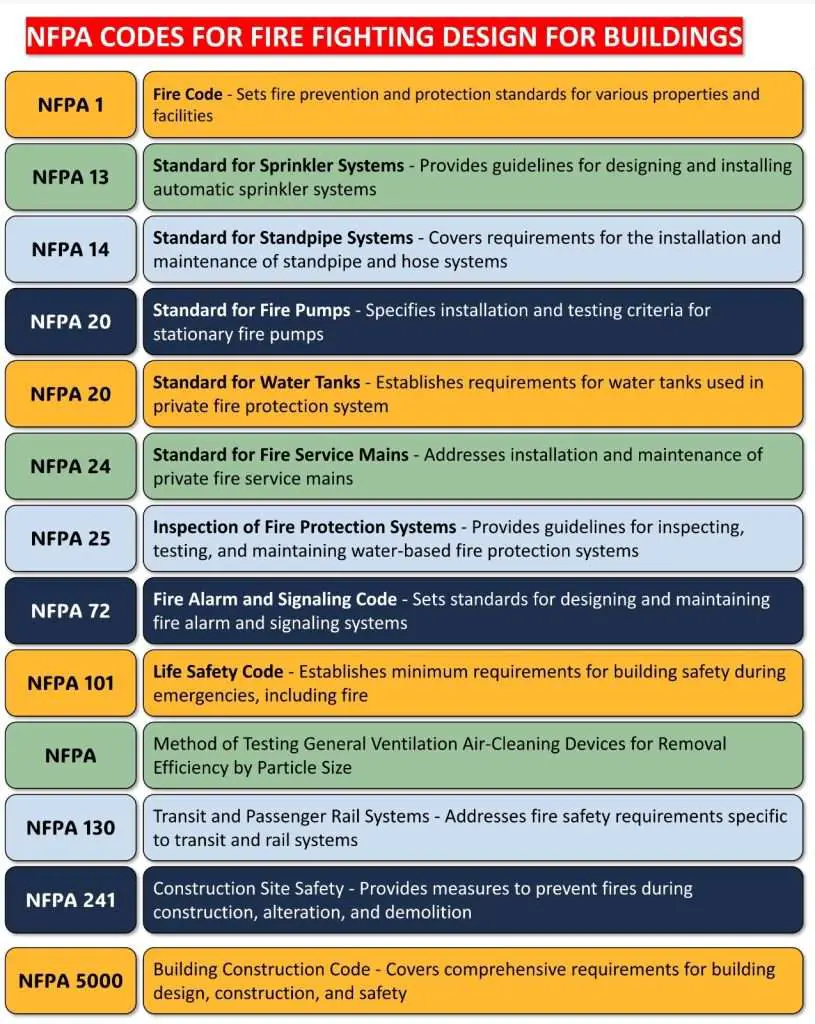
NFPA (National Fire Protection Association) is renowned for developing and maintaining hundreds of codes and standards that establish the benchmark for fire safety, prevention, and emergency response in various industries and settings. These codes and standards are critical tools in promoting best practices and ensuring the protection of lives, property, and the environment. Let’s explore some of the most important NFPA codes and standards:

NFPA 1: Fire Code

NFPA 1, the Fire Code, is a comprehensive document that addresses fire safety requirements for a wide range of occupancies, processes, and hazards. It covers fire prevention measures, fire protection systems, emergency planning, and building construction, among other topics. Local governments often adopt NFPA 1 as the basis for their fire codes.

NFPA 70: National Electrical Code (NEC)

The NEC, also known as NFPA 70, is one of the most widely used and referenced codes in the world. It governs the installation and maintenance of electrical systems to prevent fire and electrical hazards. The NEC is updated every three years to keep pace with technological advancements and industry developments.

NFPA 101: Life Safety Code

NFPA 101, the Life Safety Code, sets requirements for the design, construction, operation, and maintenance of buildings to ensure safe egress and protection from fire and related hazards. It covers a wide range of occupancies, from healthcare facilities and educational institutions to residential buildings.

NFPA 13: Standard for the Installation of Sprinkler Systems

NFPA 13 provides guidelines for the installation of automatic sprinkler systems, including design, placement, and maintenance. Sprinkler systems are essential fire protection measures that can significantly reduce the spread of fire and limit damage.

NFPA 72: National Fire Alarm and Signaling Code

NFPA 72 sets the standards for the design, installation, testing, and maintenance of fire alarm systems, signaling systems, and emergency communication systems. These systems play a crucial role in alerting occupants and emergency responders to fire incidents.

NFPA 20: Standard for the Installation of Stationary Pumps for Fire Protection

NFPA 20 provides guidelines for the installation of stationary pumps used in water supply systems for fire protection. These pumps ensure an adequate water supply for firefighting operations.

NFPA 25: Standard for the Inspection, Testing, and Maintenance of Water-Based Fire Protection Systems

NFPA 25 outlines the requirements for inspecting, testing, and maintaining water-based fire protection systems, including sprinklers, standpipes, and hydrants. Regular maintenance is crucial to ensure the reliability of these systems.

NFPA 30: Flammable and Combustible Liquids Code

NFPA 30 addresses the storage, handling, and use of flammable and combustible liquids, including fuel storage tanks, chemical facilities, and gas stations.

NFPA 70E: Standard for Electrical Safety in the Workplace

NFPA 70E guides electrical safety practices for workplaces to protect workers from electrical hazards.

NFPA 921: Guide for Fire and Explosion Investigations

NFPA 921 outlines best practices for conducting fire and explosion investigations to determine their origin and cause. This standard is essential in understanding how fires start and how to prevent similar incidents in the future.

List of NFPA Codes and Standards

The following table provides the list of NFPA Codes and Standards

Name of the NFPA Code/StandardNFPA Code/Standard Number
Fire CodeNFPA 1
Hydrogen Technologies CodeNFPA 2
Standard for Commissioning of Fire Protection and Life Safety SystemsNFPA 3
Standard for Integrated Fire Protection and Life Safety System TestingNFPA 4
Standard for Portable Fire ExtinguishersNFPA 10
Standard for Low-, Medium-, and High-Expansion FoamNFPA 11
Standard for Medium- and High-Expansion Foam SystemsNFPA 11A
Standard for Mobile Foam ApparatusNFPA 11C
Standard on Carbon Dioxide Extinguishing SystemsNFPA 12
Standard on Halon 1301 Fire Extinguishing SystemsNFPA 12A
Standard for the Installation of Sprinkler SystemsNFPA 13
Standard for the Installation of Sprinkler Systems in One- and Two-Family Dwellings and Manufactured HomesNFPA 13D
Recommended Practice for Fire Department Operations in Properties Protected by Sprinkler and Standpipe SystemsNFPA 13E
Standard for the Installation of Sprinkler Systems in Low-Rise Residential OccupanciesNFPA 13R
Standard for the Installation of Standpipe and Hose SystemsNFPA 14
Standard for Water Spray Fixed Systems for Fire ProtectionNFPA 15
Standard for the Installation of Foam-Water Sprinkler and Foam-Water Spray SystemsNFPA 16
Standard for Dry Chemical Extinguishing SystemsNFPA 17
Standard for Wet Chemical Extinguishing SystemsNFPA 17A
Standard on Wetting AgentsNFPA 18
Standard on Water Additives for Fire Control and Vapor MitigationNFPA 18A
Standard for the Installation of Stationary Pumps for Fire ProtectionNFPA 20
Standard for Water Tanks for Private Fire ProtectionNFPA 22
Standard for the Installation of Private Fire Service Mains and Their AppurtenancesNFPA 24
Standard for the Inspection, Testing, and Maintenance of Water-Based Fire Protection SystemsNFPA 25
Flammable and Combustible Liquids CodeNFPA 30
Code for Motor Fuel Dispensing Facilities and Repair GaragesNFPA 30A
Code for the Manufacture and Storage of Aerosol ProductsNFPA 30B
Standard for the Installation of Oil-Burning EquipmentNFPA 31
Standard for Drycleaning FacilitiesNFPA 32
Standard for Spray Application Using Flammable or Combustible MaterialsNFPA 33
Standard for Dipping, Coating, and Printing Processes Using Flammable or Combustible LiquidsNFPA 34
Standard for the Manufacture of Organic CoatingsNFPA 35
Standard for Solvent Extraction PlantsNFPA 36
Standard for the Installation and Use of Stationary Combustion Engines and Gas TurbinesNFPA 37
Standard for Firefighters, Fire Apparatus Drivers/Operators, Airport Firefighters, and Marine Firefighting for Land-Based Firefighters Professional QualificationsNFPA 40
Code for the Storage of Pyroxylin PlasticNFPA 42
Standard on Fire Protection for Laboratories Using ChemicalsNFPA 45
Recommended Safe Practice for Storage of Forest ProductsNFPA 46
Standard for Bulk Oxygen Systems at Consumer SitesNFPA 50
Standard for Gaseous Hydrogen Systems at Consumer SitesNFPA 50A
Standard for Liquefied Hydrogen Systems at Consumer SitesNFPA 50B
Standard for the Design and Installation of Oxygen-Fuel Gas Systems for Welding, Cutting, and Allied ProcessesNFPA 51
Standard for Acetylene Cylinder Charging PlantsNFPA 51A
Standard for Fire Prevention During Welding, Cutting, and Other Hot WorkNFPA 51B
Vehicular Natural Gas Fuel Systems CodeNFPA 52
Recommended Practice on Materials, Equipment, and Systems Used in Oxygen-Enriched AtmospheresNFPA 53
National Fuel Gas CodeNFPA 54
Compressed Gases and Cryogenic Fluids CodeNFPA 55
Standard for Fire and Explosion Prevention During Cleaning and Purging of Flammable Gas Piping SystemsNFPA 56
Liquefied Natural Gas (LNG) Vehicular Fuel Systems CodeNFPA 57
Liquefied Petroleum Gas CodeNFPA 58
Utility LP-Gas Plant CodeNFPA 59
Standard for the Production, Storage, and Handling of Liquefied Natural Gas (LNG)NFPA 59A
Standard for the Prevention of Fires and Dust Explosions in Agricultural and Food Processing FacilitiesNFPA 61
Guide on Explosion Protection for Gaseous Mixtures in Pipe SystemsNFPA 67
Standard on Explosion Protection by Deflagration VentingNFPA 68
Standard on Explosion Prevention SystemsNFPA 69
National Electrical Code®NFPA 70®
National Electrical Code® Requirements for One- and Two-Family DwellingsNFPA 70A
Standard for Electrical Equipment MaintenanceNFPA 70B
Standard for Electrical Safety in the Workplace®NFPA 70E®
National Fire Alarm and Signaling Code®NFPA 72®
Standard for Electrical Inspections for Existing DwellingsNFPA 73
Standard for the Fire Protection of Information Technology EquipmentNFPA 75
Standard for the Fire Protection of Telecommunications FacilitiesNFPA 76
Recommended Practice on Static ElectricityNFPA 77
Guide on Electrical InspectionsNFPA 78
Electrical Standard for Industrial MachineryNFPA 79
Standard for Fire Doors and Other Opening ProtectivesNFPA 80
Recommended Practice for Protection of Buildings from Exterior Fire ExposuresNFPA 80A
Standard on Incinerators and Waste and Linen Handling Systems and EquipmentNFPA 82
Boiler and Combustion Systems Hazards CodeNFPA 85
Standard for Ovens and FurnacesNFPA 86
Standard for Industrial Furnaces Using a Special Processing AtmosphereNFPA 86C
Standard for Industrial Furnaces Using Vacuum as an AtmosphereNFPA 86D
Standard for Fluid HeatersNFPA 87
Standard for Parking StructuresNFPA 88A
Standard for Repair GaragesNFPA 88B
Standard for the Installation of Air-Conditioning and Ventilating SystemsNFPA 90A
Standard for the Installation of Warm Air Heating and Air-Conditioning SystemsNFPA 90B
Standard for Exhaust Systems for Air Conveying of Vapors, Gases, Mists, and Particulate SolidsNFPA 91
Standard for Smoke Control SystemsNFPA 92
Standard for Smoke-Control Systems Utilizing Barriers and Pressure DifferencesNFPA 92A
Standard for Smoke Management Systems in Malls, Atria, and Large SpacesNFPA 92B
Standard for Ventilation Control and Fire Protection of Commercial Cooking OperationsNFPA 96
Standard Glossary of Terms Relating to Chimneys, Vents, and Heat-Producing AppliancesNFPA 97
Health Care Facilities CodeNFPA 99
Standard for Hypobaric FacilitiesNFPA 99B
Life Safety Code®NFPA 101®
Guide on Alternative Approaches to Life SafetyNFPA 101A
Code for Means of Egress for Buildings and StructuresNFPA 101B
Standard for Grandstands, Folding and Telescopic Seating, Tents, and Membrane StructuresNFPA 102
Standard for Smoke Door Assemblies and Other Opening ProtectivesNFPA 105
Standard for Emergency and Standby Power SystemsNFPA 110
Standard on Stored Electrical Energy Emergency and Standby Power SystemsNFPA 111
Standard for Laser Fire ProtectionNFPA 115
Standard for Fire Prevention and Control in Coal MinesNFPA 120
Standard on Fire Protection for Self-Propelled and Mobile Surface Mining EquipmentNFPA 121
Standard for Fire Prevention and Control in Metal/Nonmetal Mining and Metal Mineral Processing FacilitiesNFPA 122
Standard for Fire Prevention and Control in Underground Bituminous Coal MinesNFPA 123
Standard for Fixed Guideway Transit and Passenger Rail SystemsNFPA 130
Standard on Motion Picture and Television Production Studio Soundstages, Approved Production Facilities, and Production LocationsNFPA 140
Fire and Life Safety in Animal Housing Facilities CodeNFPA 150
Standard for the Use of Flame Effects Before an AudienceNFPA 160
Standard for Fire Safety and Emergency SymbolsNFPA 170
Standard for Hanging and Bracing of Fire Suppression SystemsNFPA 200
Guide on Roof Coverings and Roof Deck ConstructionsNFPA 203
Standard for Smoke and Heat VentingNFPA 204
Standard for Chimneys, Fireplaces, Vents, and Solid Fuel-Burning AppliancesNFPA 211
Standard on Water-Cooling TowersNFPA 214
Standard on Types of Building ConstructionNFPA 220
Standard for High Challenge Fire Walls, Fire Walls, and Fire Barrier WallsNFPA 221
Model Manufactured Home Installation StandardNFPA 225
Standard for the Fire Protection of StorageNFPA 230
Standard for General StorageNFPA 231
Standard for Rack Storage of MaterialsNFPA 231C
Standard for Storage of Rubber TiresNFPA 231D
Recommended Practice for the Storage of Baled CottonNFPA 231E
Standard for the Storage of Roll PaperNFPA 231F
Standard for the Protection of RecordsNFPA 232
Guide for Fire Protection for Archives and Records CentersNFPA 232A
Standard for Safeguarding Construction, Alteration, and Demolition OperationsNFPA 241
Standard Methods of Tests of Fire Resistance of Building Construction and MaterialsNFPA 251
Standard Methods of Fire Tests of Door AssembliesNFPA 252
Standard Method of Test for Critical Radiant Flux of Floor Covering Systems Using a Radiant Heat Energy SourceNFPA 253
Standard Method of Test of Surface Burning Characteristics of Building MaterialsNFPA 255
Standard Methods of Fire Tests of Roof CoveringsNFPA 256
Standard on Fire Test for Window and Glass Block AssembliesNFPA 257
Recommended Practice for Determining Smoke Generation of Solid MaterialsNFPA 258
Standard Test Method for Potential Heat of Building MaterialsNFPA 259
Standard Methods of Tests and Classification System for Cigarette Ignition Resistance of Components of Upholstered FurnitureNFPA 260
Standard Method of Test for Determining Resistance of Mock-Up Upholstered Furniture Material Assemblies to Ignition by Smoldering CigarettesNFPA 261
Standard Method of Test for Flame Travel and Smoke of Wires and Cables for Use in Air-Handling SpacesNFPA 262
Standard Methods of Fire Tests for Evaluating Room Fire Growth Contribution of Textile or Expanded Vinyl Wall Coverings on Full Height Panels and WallsNFPA 265
Standard Method of Test for Fire Characteristics of Upholstered Furniture Exposed to Flaming Ignition SourceNFPA 266
Standard Method of Test for Fire Characteristics of Mattresses and Bedding Assemblies Exposed to Flaming Ignition SourceNFPA 267
Standard Test Method for Determining Ignitability of Exterior Wall Assemblies Using a Radiant Heat Energy SourceNFPA 268
Standard Test Method for Developing Toxic Potency Data for Use in Fire Hazard ModelingNFPA 269
Standard Test Method for Measurement of Smoke Obscuration Using a Conical Radiant Source in a Single Closed ChamberNFPA 270
Standard Method of Test for Heat and Visible Smoke Release Rates for Materials and Products Using an Oxygen Consumption CalorimeterNFPA 271
Standard Method of Test for Heat and Visible Smoke Release Rates for Upholstered Furniture Components or Composites and Mattresses Using an Oxygen Consumption CalorimeterNFPA 272
Standard Test Method to Evaluate Fire Performance Characteristics of Pipe InsulationNFPA 274
Standard Method of Fire Tests for the Evaluation of Thermal BarriersNFPA 275
Standard Method of Fire Test for Determining the Heat Release Rate of Roofing Assemblies with Combustible Above-Deck Roofing ComponentsNFPA 276
Standard Methods of Tests for Evaluating Fire and Ignition Resistance of Upholstered Furniture Using a Flaming Ignition SourceNFPA 277
Standard Fire Test Method for Evaluation of Fire Propagation Characteristics of Exterior Wall Assemblies Containing Combustible ComponentsNFPA 285
Standard Methods of Fire Tests for Evaluating Contribution of Wall and Ceiling Interior Finish to Room Fire GrowthNFPA 286
Standard Test Methods for Measurement of Flammability of Materials in Cleanrooms Using a Fire Propagation Apparatus (FPA)NFPA 287
Standard Methods of Fire Tests of Horizontal Fire Door Assemblies Installed in Horizontal Fire Resistance-Rated AssembliesNFPA 288
Standard Method of Fire Test for Individual Fuel PackagesNFPA 289
Standard for Fire Testing of Passive Protection Materials for Use on LP-Gas ContainersNFPA 290
Recommended Practice for Water Flow Testing and Marking of HydrantsNFPA 291
Standard for Wildfire ControlNFPA 295
Guide on Principles and Practices for Communications SystemsNFPA 297
Standard on Foam Chemicals for Wildland Fire ControlNFPA 298
Standard for Protection of Life and Property from WildfireNFPA 299
Code for Safety to Life from Fire on Merchant VesselsNFPA 301
Fire Protection Standard for Pleasure and Commercial Motor CraftNFPA 302
Fire Protection Standard for Marinas and BoatyardsNFPA 303
Standard for the Control of Gas Hazards on VesselsNFPA 306
Standard for the Construction and Fire Protection of Marine Terminals, Piers, and WharvesNFPA 307
Standard for Fire Protection of Vessels During Construction, Conversion, Repair, and Lay-UpNFPA 312
Standard for the Protection of Semiconductor Fabrication FacilitiesNFPA 318
Standard for the Safeguarding of Tanks and Containers for Entry, Cleaning, or RepairNFPA 326
Recommended Practice for the Control of Flammable and Combustible Liquids and Gases in Manholes, Sewers, and Similar Underground StructuresNFPA 328
Recommended Practice for Handling Releases of Flammable and Combustible Liquids and GasesNFPA 329
Guide for Safe Confined Space Entry and WorkNFPA 350
Standard for Tank Vehicles for Flammable and Combustible LiquidsNFPA 385
Standard for Portable Shipping Tanks for Flammable and Combustible LiquidsNFPA 386
Standard for the Storage of Flammable and Combustible Liquids at Farms and Isolated SitesNFPA 395
Hazardous Materials CodeNFPA 400
Recommended Practice for the Prevention of Fires and Uncontrolled Chemical Reactions Associated with the Handling of Hazardous WasteNFPA 401
Guide for Aircraft Rescue and Fire-Fighting OperationsNFPA 402
Standard for Aircraft Rescue and Fire-Fighting Services at AirportsNFPA 403
Standard for the Recurring Proficiency of Airport Fire FightersNFPA 405
Standard for Aircraft Fuel ServicingNFPA 407
Standard for Aircraft Hand Portable Fire ExtinguishersNFPA 408
Standard on Aircraft HangarsNFPA 409
Standard on Aircraft MaintenanceNFPA 410
Standard for Evaluating Aircraft Rescue and Fire-Fighting Foam EquipmentNFPA 412
Standard for Aircraft Rescue and Fire-Fighting VehiclesNFPA 414
Standard on Airport Terminal Buildings, Fueling Ramp Drainage, and Loading WalkwaysNFPA 415
Standard for HeliportsNFPA 418
Standard on Fire Protection of Cannabis Growing and Processing FacilitiesNFPA 420
Guide for Aircraft Accident/Incident Response AssessmentNFPA 422
Standard for Construction and Protection of Aircraft Engine Test FacilitiesNFPA 423
Guide for Airport/Community Emergency PlanningNFPA 424
Code for the Storage of Liquid and Solid OxidizersNFPA 430
Code for the Storage of Organic Peroxide FormulationsNFPA 432
Code for the Storage of PesticidesNFPA 434
Guide for Aircraft Rescue and Firefighting Operations and Airport/Community Emergency PlanningNFPA 440
Guide for Emergency Medical Services and SystemsNFPA 450
Guide for Community Health Care ProgramsNFPA 451
Guide for Emergency Medical Services and Systems and Community Health Care ProgramsNFPA 455
Standard for Aircraft Rescue and Firefighting Services at AirportsNFPA 460
Standard for Fire Protection of Spaceport FacilitiesNFPA 461
Hazardous Materials/Weapons of Mass Destruction (WMD) Standard for RespondersNFPA 470
Recommended Practice for Responding to Hazardous Materials IncidentsNFPA 471
Standard for Competence of Responders to Hazardous Materials/Weapons of Mass Destruction IncidentsNFPA 472
Standard for Competencies for EMS Personnel Responding to Hazardous Materials/Weapons of Mass Destruction IncidentsNFPA 473
Recommended Practice for Organizing, Managing, and Sustaining a Hazardous Materials/Weapons of Mass Destruction Response ProgramNFPA 475
Standard for the Storage, Handling, and Processing of Magnesium Solids and PowdersNFPA 480
Standard for the Production, Processing, Handling, and Storage of TitaniumNFPA 481
Standard for the Production, Processing, Handling, and Storage of ZirconiumNFPA 482
Standard for Combustible MetalsNFPA 484
Standard for the Storage, Handling, Processing, and Use of Lithium MetalNFPA 485
Code for the Storage of Ammonium NitrateNFPA 490
Explosive Materials CodeNFPA 495
Standard for Purged and Pressurized Enclosures for Electrical EquipmentNFPA 496
Recommended Practice for the Classification of Flammable Liquids, Gases, or Vapors and of Hazardous (Classified) Locations for Electrical Installations in Chemical Process AreasNFPA 497
Standard for Safe Havens and Interchange Lots for Vehicles Transporting ExplosivesNFPA 498
Recommended Practice for the Classification of Combustible Dusts and of Hazardous (Classified) Locations for Electrical Installations in Chemical Process AreasNFPA 499
Standard on Manufactured HousingNFPA 501
Standard for Fire Safety Criteria for Manufactured Home Installations, Sites, and CommunitiesNFPA 501A
Standard for Road Tunnels, Bridges, and Other limited-access highwaysNFPA 502
Fire Safety Standard for Powered Industrial Trucks Including Type Designations, Areas of Use, Conversions, Maintenance, and OperationsNFPA 505
Standard for Motor Freight TerminalsNFPA 513
Standard on Subterranean SpacesNFPA 520
Guide to the Fire Safety Concepts TreeNFPA 550
Guide for the Evaluation of Fire Risk AssessmentsNFPA 551
Guide on Methods for Evaluating Potential for Room FlashoverNFPA 555
Guide on Methods for Evaluating Fire Hazard to Occupants of Passenger Road VehiclesNFPA 556
Standard for Determination of Fire Loads for Use in Structural Fire Protection DesignNFPA 557
Standard for the Storage, Handling, and Use of Ethylene Oxide for Sterilization and FumigationNFPA 560
Standard on Facility Fire BrigadesNFPA 600
Standard for Security Services in Fire Loss PreventionNFPA 601
Guide for Emergency and Safety Operations at Motorsports VenuesNFPA 610
Standard for Pneumatic Conveying Systems for Handling Combustible Particulate SolidsNFPA 650
Standard for the Machining and Finishing of Aluminum and the Production and Handling of Aluminum PowdersNFPA 651
Standard on the Fundamentals of Combustible DustNFPA 652
Standard for the Prevention of Fire and Dust Explosions from the Manufacturing, Processing, and Handling of Combustible Particulate SolidsNFPA 654
Standard for Prevention of Sulfur Fires and ExplosionsNFPA 655
Standard for Combustible DustsNFPA 660
Standard for the Prevention of Fires and Explosions in Wood Processing and Woodworking FacilitiesNFPA 664
Standard Methods of Fire Tests for Flame Propagation of Textiles and FilmsNFPA 701
Standard for Fire-Retardant-Treated Wood and Fire-Retardant Coatings for Building MaterialsNFPA 703
Standard System for the Identification of the Hazards of Materials for Emergency ResponseNFPA 704
Recommended Practice for a Field Flame Test for Textiles and FilmsNFPA 705
Standard for the Installation of Fuel Gases Detection and Warning EquipmentNFPA 715
Standard for the Installation of Carbon Monoxide(CO) Detection and Warning EquipmentNFPA 720
Guide for Premises SecurityNFPA 730
Standard for the Installation of Premises Security SystemsNFPA 731
Standard on Water Mist Fire Protection SystemsNFPA 750
Standard on Hybrid (Water and Inert Gas) Fire-Extinguishing SystemsNFPA 770
Standard for the Installation of Lightning Protection SystemsNFPA 780
Standard for Competency of Third-Party Field Evaluation BodiesNFPA 790
Recommended Practice and Procedures for Unlabeled Electrical Equipment EvaluationNFPA 791
Standard for Fire Protection for Facilities Handling Radioactive MaterialsNFPA 801
Standard for Fire Protection for Light Water Nuclear Power PlantsNFPA 803
Standard for Fire Protection for Advanced Light Water Reactor Electric Generating PlantsNFPA 804
Performance-Based Standard for Fire Protection for Light Water Reactor Electric Generating PlantsNFPA 805
Performance-Based Standard for Fire Protection for Advanced Nuclear Reactor Electric Generating Plants Change ProcessNFPA 806
Standard for Fire Protection in Wastewater Treatment and Collection FacilitiesNFPA 820
Recommended Practice for Fire Protection for Electric Generating Plants and High Voltage Direct Current Converter StationsNFPA 850
Recommended Practice for Fire Protection for Hydroelectric Generating PlantsNFPA 851
Standard for the Installation of Stationary Fuel Cell Power SystemsNFPA 853
Standard for the Installation of Stationary Energy Storage SystemsNFPA 855
Building Energy CodeNFPA 900
Standard Classifications for Fire and Emergency Services Incident ReportingNFPA 901
Fire Reporting Field Incident GuideNFPA 902
Fire Reporting Property Survey GuideNFPA 903
Incident Follow-up Report GuideNFPA 904
Guide for Fire Incident Field NotesNFPA 906
Code for the Protection of Cultural Resource Properties – Museums, Libraries, and Places of WorshipNFPA 909
Code for the Protection of Historic StructuresNFPA 914
Standard for Remote Inspections and TestsNFPA 915
Guide for Fire and Explosion InvestigationsNFPA 921
Standard for Data Development and Exchange for the Fire ServiceNFPA 950
Guide to Building and Utilizing Digital InformationNFPA 951
Standard for Fire Service Professional Qualifications Accreditation and Certification SystemsNFPA 1000
Standard for Fire Fighter Professional QualificationsNFPA 1001
Standard for Fire Apparatus Driver/Operator Professional QualificationsNFPA 1002
Standard for Airport Fire Fighter Professional QualificationsNFPA 1003
Standard for Professional Qualifications for Marine Fire Fighting for Land-Based Fire FightersNFPA 1005
Standard for Technical Rescue Personnel Professional QualificationsNFPA 1006
Standard for Firefighters, Fire Apparatus Drivers/Operators, Airport Firefighters, and Marine Firefighting for Land-Based Firefighters Professional QualificationsNFPA 1010
Standard for Fire Officer and Emergency Services Instructor Professional QualificationsNFPA 1020
Standard for Fire Officer Professional QualificationsNFPA 1021
Standard for Fire and Emergency Services Analyst Professional QualificationsNFPA 1022
Standard for Incident Management Personnel Professional QualificationsNFPA 1026
Standard for Professional Qualifications for Fire Prevention Program PositionsNFPA 1030
Standard for Professional Qualifications for Fire Inspector and Plan ExaminerNFPA 1031
Standard for Professional Qualifications for Fire InvestigatorNFPA 1033
Standard on Fire and Life Safety Educator, Public Information Officer, Youth Firesetter Intervention Specialist, and Youth Firesetter Program Manager Professional QualificationsNFPA 1035
Standard on Fire Marshal Professional QualificationsNFPA 1037
Standard for Fire and Emergency Services Instructor Professional QualificationsNFPA 1041
Standard for Wildland Firefighting Personnel Professional QualificationsNFPA 1051
Standard for Public Safety Telecommunications Personnel Professional QualificationsNFPA 1061
Standard for Emergency Vehicle Technician Professional QualificationsNFPA 1071
Standard for Hazardous Materials/Weapons of Mass Destruction Emergency Response Personnel Professional QualificationsNFPA 1072
Standard for Electrical Inspector Professional QualificationsNFPA 1078
Standard for Facility Fire Brigade Member Professional QualificationsNFPA 1081
Standard for Facilities Fire and Life Safety Director Professional QualificationsNFPA 1082
Standard for Traffic Incident Management Personnel Professional QualificationsNFPA 1091
Code for Model RocketryNFPA 1122
Code for Fireworks DisplayNFPA 1123
Code for the Manufacture, Transportation, and Storage of Fireworks and Pyrotechnic ArticlesNFPA 1124
Code for the Manufacture of Model Rocket and High-Power Rocket MotorsNFPA 1125
Standard for the Use of Pyrotechnics Before a Proximate AudienceNFPA 1126
Code for High Power RocketryNFPA 1127
Standard Method of Fire Test for Flame BreaksPYR 1128
Standard Method of Fire Test for Covered Fuse on Consumer FireworksPYR 1129
Standard for Wildland Fire ProtectionNFPA 1140
Standard for Fire Protection Infrastructure for Land Development in Wildland, Rural, and Suburban AreasNFPA 1141
Standard on Water Supplies for Suburban and Rural FirefightingNFPA 1142
Standard for Wildland Fire ManagementNFPA 1143
Standard for Reducing Structure Ignition Hazards from Wildland FireNFPA 1144
Guide for the Use of Class A Foams in Fire FightingNFPA 1145
Standard on Foam Chemicals for Fires in Class A FuelsNFPA 1150
Standard on Recreational VehiclesNFPA 1192
Standard for Recreational Vehicle Parks and CampgroundsNFPA 1194
Standard for Providing Fire and Emergency Services to the PublicNFPA 1201
Standard for the Installation, Maintenance, and Use of Emergency Services Communications SystemsNFPA 1221
Standard for Emergency Services CommunicationsNFPA 1225
Standard on Water Supplies for Suburban and Rural Fire FightingNFPA 1231
Recommended Practice in Fire and Emergency Service Organization Risk ManagementNFPA 1250
Standard on Community Risk Assessment and Community Risk Reduction Plan DevelopmentNFPA 1300
Standard for Fire Investigation UnitsNFPA 1321
Standard on Fire Service TrainingNFPA 1400
Recommended Practice for Fire Service Training Reports and RecordsNFPA 1401
Standard on Facilities for Fire Training and Associated PropsNFPA 1402
Standard on Live Fire Training EvolutionsNFPA 1403
Standard for Fire Service Respiratory Protection TrainingNFPA 1404
Guide for Land-Based Fire Departments that Respond to Marine Vessel FiresNFPA 1405
Standard for Training Fire Service Rapid Intervention CrewsNFPA 1407
Standard for Training Fire Service Personnel in the Operation, Care, Use, and Maintenance of Thermal ImagersNFPA 1408
Standard on Training for Emergency Scene OperationsNFPA 1410
Standard for a Fire and Emergency Service Vehicle Operations Training ProgramNFPA 1451
Guide for Training Fire Service Personnel to Conduct Community Risk Reduction for Residential OccupanciesNFPA 1452
Standard on Fire Department Occupational Safety, Health, and Wellness ProgramNFPA 1500™
Standard for Fire Department Safety Officer Professional QualificationsNFPA 1521
Standard for Emergency Responder Health and SafetyNFPA 1550
Standard on Emergency Services Incident Management System and Command SafetyNFPA 1561
Standard for Emergency Responder Occupational Health and WellnessNFPA 1580
Standard on Fire Department Infection Control ProgramNFPA 1581
Standard on Comprehensive Occupational Medical Program for Fire DepartmentsNFPA 1582
Standard on Health-Related Fitness Programs for Fire Department MembersNFPA 1583
Standard on the Rehabilitation Process for Members During Emergency Operations and Training ExercisesNFPA 1584
Standard for Exposure and Contamination ControlNFPA 1585
Standard on Continuity, Emergency, and Crisis ManagementNFPA 1600®
Standard on Mass Evacuation, Sheltering, and Re-entry ProgramsNFPA 1616
Standard for Pre-Incident PlanningNFPA 1620
Standard for Emergency, Continuity, and Crisis Management: Preparedness, Response, and RecoveryNFPA 1660
Standard on Operations and Training for Technical Search and Rescue IncidentsNFPA 1670
Guide for Structural Fire FightingNFPA 1700
Standard for the Organization and Deployment of Fire Suppression Operations, Emergency Medical Operations, and Special Operations to the Public by Career Fire DepartmentsNFPA 1710
Standard for the Organization and Deployment of Fire Suppression Operations, Emergency Medical Operations, and Special Operations to the Public by Volunteer Fire DepartmentsNFPA 1720
Standard on Organization and Deployment of Fire Prevention Inspection and Code Enforcement, Plan Review, Investigation, and Public Education OperationsNFPA 1730
Standard for the Organization and Deployment of Fire Suppression Operations, Emergency Medical Operations, and Providing Fire and Emergency Services to the PublicNFPA 1750
Standard on Thermal Imagers for the Fire ServiceNFPA 1801
Standard on Two-Way, Portable RF Voice Communications Devices for Use by Emergency Services Personnel in the Hazard ZoneNFPA 1802
Standard on Protective Ensembles for Structural and Proximity Firefighting and Self-Contained Breathing Apparatus (SCBA)NFPA 1850
Standard on Selection, Care, and Maintenance of Protective Ensembles for Structural Fire Fighting and Proximity Fire FightingNFPA 1851
Standard on Selection, Care, and Maintenance of Open-Circuit Self-Contained Breathing Apparatus (SCBA)NFPA 1852
Standard on Selection, Care, and Maintenance of Protective Ensembles for Technical Rescue IncidentsNFPA 1855
Standard on Selection, Care, and Maintenance of Protective Ensembles for Technical Rescue Incidents and Wildland FirefightingNFPA 1857
Standard on Selection, Care, and Maintenance of Life Safety Rope and Equipment for Emergency ServicesNFPA 1858
Standard on Selection, Care, and Maintenance of Tactical Operations Video EquipmentNFPA 1859
Standard on Selection, Care, and Maintenance of Wildland Firefighting Protective Clothing and EquipmentNFPA 1877
Standard on Selection, Care, and Maintenance of Hazardous Materials, CBRN, and Emergency Medical Operations Clothing and EquipmentNFPA 1891
Standard for Aircraft Rescue and Firefighting Vehicles, Automotive Fire Apparatus, Wildland Fire Apparatus, and Automotive AmbulancesNFPA 1900
Standard for Automotive Fire ApparatusNFPA 1901
Standard for Wildland Fire ApparatusNFPA 1906
Standard for the Inspection, Maintenance, Refurbishment, Testing, and Retirement of In-Service Emergency Vehicles and Marine Firefighting VesselsNFPA 1910
Standard for the Inspection, Maintenance, Testing, and Retirement of In-Service Emergency VehiclesNFPA 1911
Standard for Fire Apparatus RefurbishingNFPA 1912
Standard for Testing Fire Department Aerial DevicesNFPA 1914
Standard for Fire Apparatus Preventive Maintenance ProgramNFPA 1915
Standard for Automotive AmbulancesNFPA 1917
Standard on Marine Fire-Fighting VesselsNFPA 1925
Standard on Fire and Emergency Service Use of Thermal Imagers, Two-Way Portable RF Voice Communication Devices, Ground Ladders, and Fire Hose, and Fire Hose AppliancesNFPA 1930
Standard for Manufacturer’s Design of Fire Department Ground LaddersNFPA 1931
Standard on Use, Maintenance, and Service Testing of In-Service Fire Department Ground LaddersNFPA 1932
Standard on Rescue ToolsNFPA 1936
Standard for the Selection, Care, and Maintenance of Rescue ToolsNFPA 1937
Standard on Protective Clothing, Ensembles, and Equipment for Technical Rescue Incidents, Emergency Medical Operations, Wildland Firefighting, and Urban Interface FirefightingNFPA 1950
Standard on Protective Ensembles for Technical Rescue IncidentsNFPA 1951
Standard on Surface Water Operations Protective Clothing and EquipmentNFPA 1952
Standard on Protective Ensembles for Contaminated Water DivingNFPA 1953
Standard on Surface Water Operations Protective Clothing and Equipment and Protective Ensembles for Contaminated Water DivingNFPA 1955
Standard for Fire Hose Connections, Spray Nozzles, Manufacturer’s Design of Fire Department Ground Ladders, Fire Hoses, and Powered Rescue ToolsNFPA 1960
Standard on Fire HoseNFPA 1961
Standard for the Care, Use, Inspection, Service Testing, and Replacement of Fire Hose, Couplings, Nozzles, and Fire Hose AppliancesNFPA 1962
Standard for Fire Hose ConnectionsNFPA 1963
Standard for Spray Nozzles and AppliancesNFPA 1964
Standard for Fire Hose AppliancesNFPA 1965
Standard on Protective Ensembles for Structural and Proximity Firefighting, Work Apparel and Open-Circuit Self-Contained Breathing Apparatus (SCBA) for Emergency Services, and Personal Alert Safety Systems (PASS)NFPA 1970
Standard on Protective Ensembles for Structural Fire Fighting and Proximity Fire FightingNFPA 1971
Standard on Emergency Services Work ApparelNFPA 1975
Standard on Protective Ensemble for Proximity Fire FightingNFPA 1976
Standard on Protective Clothing and Equipment for Wildland Fire Fighting and Urban Interface Fire FightingNFPA 1977
Standard on Open-Circuit Self-Contained Breathing Apparatus (SCBA) for Emergency ServicesNFPA 1981
Standard on Personal Alert Safety Systems (PASS)NFPA 1982
Standard on Life Safety Rope and Equipment for Emergency ServicesNFPA 1983
Standard on Respirators for Wildland Fire-Fighting Operations and Wildland Urban Interface OperationsNFPA 1984
Standard on Breathing Air Quality for Emergency Services Respiratory Protection and Respirators for Wildland Firefighting and Wildland Urban Interface OperationsNFPA 1985
Standard on Respiratory Protection Equipment for Tactical and Technical OperationsNFPA 1986
Standard on Combination Unit Respirator Systems for Tactical and Technical OperationsNFPA 1987
Standard on Breathing Air Quality for Emergency Services Respiratory ProtectionNFPA 1989
Standard for Protective Ensembles for Hazardous Materials and CBRN OperationsNFPA 1990
Standard on Vapor-Protective Ensembles for Hazardous Materials Emergencies and CBRN Terrorism IncidentsNFPA 1991
Standard on Liquid Splash-Protective Ensembles and Clothing for Hazardous Materials EmergenciesNFPA 1992
Standard on Protective Ensembles for First Responders to Hazardous Materials Emergencies and CBRN Terrorism IncidentsNFPA 1994
Standard on Protective Clothing and Ensembles for Emergency Medical OperationsNFPA 1999
Standard on Clean Agent Fire Extinguishing SystemsNFPA 2001
Standard for Fixed Aerosol Fire-Extinguishing SystemsNFPA 2010
Standard on Flame-Resistant Clothing for Protection of Industrial Personnel Against Short-Duration Thermal Exposures from FireNFPA 2112
Standard on Selection, Care, Use, and Maintenance of Flame-Resistant Garments for the Protection of Industrial Personnel Against Short-Duration Thermal Exposures from FireNFPA 2113
Standard for Small Unmanned Aircraft Systems (sUAS) Used for Public Safety OperationsNFPA 2400
Standard for Operations and Training for Technical Search and Rescue Incidents and Life Safety Rope and Equipment for Emergency ServicesNFPA 2500
Standard on Facility Emergency Action PlansNFPA 2800
Standard for an Active Shooter/Hostile Event Response (ASHER) ProgramNFPA 3000
Building Construction and Safety CodeNFPA 5000
Standard for Single-Burner Boiler OperationNFPA 8501
Standard for the Prevention of Furnace Explosions/Implosions in Multiple Burner BoilersNFPA 8502
Standard for Pulverized Fuel SystemsNFPA 8503
Standard on Atmospheric Fluidized-Bed Boiler OperationNFPA 8504
Standard for Stoker OperationNFPA 8505
Standard on Heat Recovery Steam Generator SystemsNFPA 8506
Table 1: List of NFPA Codes and Standards

The image in Fig. 1 shows the major NFPA Codes for Fire Fighting Design for Buildings.

NFPA Codes for Fire Fighting Design for Buildings
FIg. 1: NFPA Codes for Fire-Fighting Design for Buildings

Collaborations and Partnerships

The NFPA understands that collaboration is key to effectively addressing fire safety issues. The association works closely with government agencies, other standard-setting organizations, research institutions, and various industries to develop comprehensive fire safety solutions.

Conclusion

The National Fire Protection Association plays a pivotal role in reducing the devastation caused by fires in the United States and beyond. Through its robust research, comprehensive codes and standards, education initiatives, and commitment to technological advancement, the NFPA continues to be a guiding force in the world of fire safety. As fires continue to be a significant threat to lives and property, the tireless efforts of the NFPA remain indispensable in protecting communities and promoting a safer future.

Introduction to Composite Piping System

The application of composite structures starts in 1500 B.C., and their notable developments date back to 1940[1] here GFRPs were used to replace the traditional wood or metal structures in the marine industry. This application is mainly due to its corrosion-resistant properties, high stiffness-to-weight ratio, and increased fatigue life. These features have increased the value of GFRP, making it the primary consideration for the construction of boats, vessels, and ships. Besides this industry, other critical industries such as aerospace, defense, automotive, and petroleum expect an increased demand. Advanced composite materials were primarily developed for aerospace to enhance commercial and military aircraft[2]. The materials are still contributing a notable role in the current and potential future aerospace components. Presently, the Airbus A350 XWB and its American counterpart, the Boeing 787 Dreamliner, are constructed of more than 50% composite materials [3].

Fig. 1: Composition of Composite Piping System

Composition of Composite Piping System

The Fiber-Reinforced Polymer (FRP) is fundamentally developed from three important raw materials namely:

  • Fiber system: Natural (Basalt, Cotton, Flax, etc) or Synthetic (Glass, Carbon, Kevlar, etc).
  • Matrix/Resin system: Epoxy, Vinylester, Polyester, etc.
  • Hardener system: Aliphatic Amine, Aromatic Amine, Anhydride, etc.

Fabrication of Composite Piping System

Hand-layup method for Composite Pipe Manufacturing
Fig. 2: Hand-layup method for Composite Pipe Manufacturing

To fabricate FRP, hand layup is a well-known technique and has been used since the beginning of a composite structure. Despite the more flexible design and easy application, it is not suited for cylindrical FRP structures such as piping, pipeline, tubing, casing as well as a pressure vessel. Hence, a more optimized fabrication method is introduced namely filament winding. This method is either fully or semi-automated depending on the design of cylindrical structures.

Filament-winding method
Fig. 3: Filament-winding method

Filament wound composite tubes are widely used in the aerospace, automotive, marine, construction, and sporting industries. In general, fiber reinforcements in composite materials are used to enhance mechanical properties and environmental resistance when subjected to harsh conditions. Commercial synthetic continuous fibers such as carbon and E-glass made the composite tubes increasingly popular [1-4]. The carbon and glass fibers as reinforcements in composites have outstanding mechanical and thermal properties as well as durability. Though, the most common fiber reinforcement in resin, GFRP, has been widely used in the structural replacement or retrofitting of steel parts in recent years due to its excellent mechanical properties and chemical stability[4-6]. GFRP structures can withstand the hydrostatic forces by positioning the fibers in the tangential direction to increase the hoop strength, making the GFRP tubular structures anisotropically stronger than their metal counterparts. Nevertheless, CFRP is comparatively more costly than other types of FRPs. In order to reduce the cost of the material, thick GFRP is used to replace it [7, 8]. GFRP piping system is a more cost-effective alternative to corrosion-prone metallic piping and non-reinforced thermoplastics. The advancement of composite materials and complete acceptance of their application as a temporary repair mechanism can attribute to the pulling factors of using it as an alternative product to metal.

The increased application of composite materials drives a significant amount of research activities, particularly in the mechanics of composite and the prediction of failure under a range of loading conditions. Due to deterioration, especially without proper control and mitigation regimes, most metallic structures will require repair and maintenance within the service life. This issue will cause a series of unnecessary asset shutdowns that will affect the other equipment integrity and increase operating expenditure.

Advantages of Composite Piping System

The advantages of GFRP include the elimination of corrosion and corrosion-related costs. It has superior corrosion resistance compared to conventional carbon steel and removes the need for expensive mitigation requirements such as corrosion inhibitors and cathodic protection. Furthermore, it requires zero maintenance and inspection. Inspection costs for intelligent pigging and/or inspection to monitor carbon steel piping corrosion can be saved when applying GFFP systems. For firewater lines, sprinklers, and deluge systems, the internal corrosion of traditional piping like carbon steel can lead to blockage of the firewater sprinkler that compromises the system’s safe operation. Also, the GFRP system does not need external coatings for buried pipelines. For aboveground piping, an integrated U.V. stabilization package avoids the use of external coatings.

Moreover, it has a superior fluid flow performance due to greater internal diameter and no scaling and bore restriction issues. GFRP reduces pumping costs compared to carbon steel of the same nominal diameter due to the low friction, which exhibits low-pressure loss. Apart from this, the main reason for their popularity are the outstanding weight-specific stiffness and strength values which enable lighter structures and hence reduced energy consumption and suited for retrofit application in marine vessels. . It has a lower weight than steel counterparts; hence, the lower weight results in more straightforward and more cost-effective pipe handling. For offshore structures, weight-saving is crucial to limit total structure weight and reduce the required structural footprint.  Lower weight promotes easier handling, reducing the need for lifting equipment, which reduces lifecycle and installation costs. However, these benefits are gained with higher material costs. By replacing the metallic piping system in the marine and offshore assets, the lower assembly costs can counterbalance the higher costs for the material.

Metallic vs Composite Piping System

Despite the advantages, fiberglass products have a number of complicating factors compared to those familiar with metal pipes. The properties of the material are different for the hoop and the axial direction, and the properties vary because they can be customized for each specific application. The anisotropic behavior of the materials is more difficult to design relative to its isotropic metallic counterpart. Efficient research philosophy in the design and fabrication will result in outstanding quality and performance of FRP piping systems which require no maintenance throughout the design life. As opposed to the metallic piping product, which is relatively easier to design and fabricate, more efforts are needed throughout the design life to tackle the corrosion issue, routine maintenance, asset shutdown, and risk of failure.

Few more related articles.

Overview of GRP Pipes
An Article on HYDROSTATIC FIELD TEST of GRP / GRE lines
Stress Analysis of GRP / GRE / FRP piping system using Caesar II
Basic Principles for an aboveground GRP piping system
Buried GRP/FRP pipe Laying and Installation Procedure
Stress Analysis of GRP / GRE / FRP Piping using START-PROF

References:

  • [1]        W. G. Roeseler, B. Sarh, M. U. Kismarton, J. Quinlivan, J. Sutter, and D. Roberts, “Composite structures: the first 100 years,” in 16th International Conference on Composite Materials, 2007, pp. 1-41: Japan Society for Composite Materials Kyoto, Japan.
  • [2]        C. Soutis, “Fiber-reinforced composites in aircraft construction,” Progress in Aerospace Sciences, vol. 41, no. 2, pp. 143-151, 2005/02/01/ 2005.
  • [3]        P. A. Toensmeier, “Advanced composites soar to new heights in Boeing 787,” Plastics Engineering, vol. 61, no. 8, pp. 8-8, 2005.
  • [4]        J. Cadei, T. Stratford, L. Hollaway, and W. Dcukett, Strengthening metallic structures using externally bonded fiber-reinforced polymers. Ciria, 2004.
  • [5]        X.-L. Zhao and L. Zhang, “State-of-the-art review on FRP strengthened steel structures,” Engineering Structures, vol. 29, no. 8, pp. 1808-1823, 2007/08/01/ 2007.
  • [6]        D. Schnerch, M. Dawood, S. Rizkalla, and E. Sumner, “Proposed design guidelines for the strengthening of steel bridges with FRP materials,” Construction and Building Materials, vol. 21, no. 5, pp. 1001-1010, 2007/05/01/ 2007.
  • [7]        A. A. El Damatty, M. Abushagur, and M. A. Youssef, “Rehabilitation of Composite Steel Bridges Using GFRP Plates,” Applied Composite Materials, vol. 12, no. 5, pp. 309-325, 2005/09/01 2005. [8]        R. Rameshni, “Innovative hybrid FRP/steel splice details for modular bridge expansion joints,” 2011.